
Buying or Selling a Horse Property on Massachusetts' North Shore
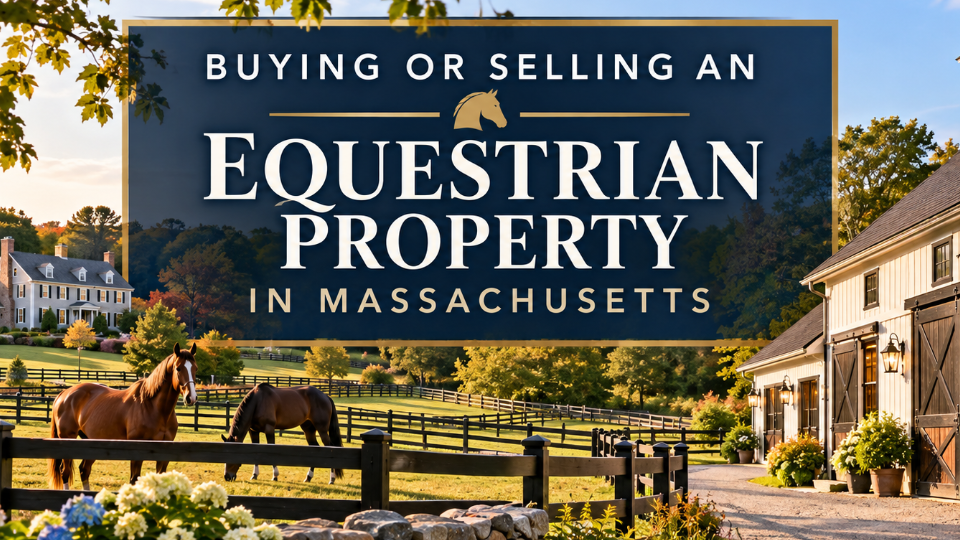
A horse property is not just a house with a bigger yard. When you buy or sell one, you're dealing with a home, a small agricultural operation, and a piece of land that may come with its own tax status, zoning protections, and environmental rules. Get those details right and the transaction goes smoothly. Miss one, and it can cost real money or derail a closing.
I've spent my whole life on the North Shore, and before real estate I earned a degree in conservation technology and ran a landscape business. Land, water, and how people use them have always interested me. In Essex County, towns like Hamilton, Wenham, Topsfield, Boxford, Ipswich, Georgetown, and Groveland have a long equestrian tradition, and these properties come up often enough that it's worth explaining how they work. You can see what's currently available on our North Shore and Massachusetts equestrian properties page.
For Buyers: What to Look at Beyond the House
Zoning and the Massachusetts agricultural exemption
The first question I ask with any horse property is whether the horses are allowed to stay, and on what terms. Massachusetts gives agriculture meaningful protection. Under Chapter 40A, Section 3 of the state zoning law, towns can't prohibit or unreasonably regulate agricultural use on parcels of five acres or more, or on parcels of two acres or more that generate at least $1,000 per acre in annual sales. State law defines agriculture to include raising livestock, horses included, and keeping horses as a commercial enterprise.
Smaller properties, and properties below those thresholds, fall back on local zoning. Many North Shore towns allow a few horses on residential lots that meet minimum lot and setback rules. Others require special permits. The answer can be very different from one town line to the next, so it's something to confirm before you fall in love with the barn.
Separately, many towns require a board of health permit to keep horses, and local animal inspectors typically visit barns once a year. None of this is a reason to avoid a horse property. It just means the paperwork should be checked and transferred properly.
Chapter 61A: a tax break with strings attached
Many larger horse farms are enrolled in Chapter 61A, the state program that taxes qualifying agricultural land at its farm value instead of its development value. To qualify, a property generally needs at least five acres in active agricultural use and at least $500 in annual gross sales from the first five acres, and horses are on the list of eligible farm animals. The savings can be substantial.
The strings matter, though. If the land comes out of agricultural use, the owner may owe rollback taxes covering the current year plus the four years before it, with interest. If the property is being sold or converted for residential, commercial, or industrial use, the town gets a 120-day right of first refusal to match a bona fide offer. If you're buying a 61A property, find out whether you intend to keep it in the program and whether you'll realistically meet the requirements. Your attorney and the town assessor should be part of that conversation early. This is legal and tax territory, and I always bring in the right professionals rather than guess.
Pasture, water, and wetlands
Acreage on paper and usable acreage are two different things. A ten-acre listing may have four acres of steep woods and two acres of wet meadow. A common rule of thumb is roughly one and a half to two acres of good pasture per horse if you want them grazing, less if you plan on dry lots and hay. Walk the land after a heavy rain if you can. Standing water in paddocks and around the barn is a maintenance problem and a hoof-health problem.
Wetlands are a big deal on the North Shore. Under the Massachusetts Wetlands Protection Act, work within the 100-foot buffer zone around a wetland generally needs review by the local conservation commission. That can affect plans for a new run-in shed, an expanded arena, or even regrading a paddock. If you have plans for the property, find out what's possible before you buy, not after.
Water supply matters too. Horses drink a lot, and many of these properties are on private wells and septic systems. A well flow test and a Title 5 septic inspection are worth doing, and you should know where the manure pile sits relative to the well and any wetlands.
The barn, fencing, and the arena
A standard home inspector will look at the barn, but often only briefly. I recommend a separate look from someone who knows equine facilities: structure and roof, electrical in the barn (a real fire risk if it's old or overloaded), stall condition, ventilation, drainage, and the water lines to the barn and paddocks. Fencing is expensive to replace, so take an honest look at what's there. If there's a riding ring, ask about the footing and the base under it.
Trails and neighbors
For many riders, the trails are as important as the property. Bradley Palmer State Park, which straddles Topsfield and Hamilton, allows horseback riding and has trailer parking. The Essex County Trail Association maintains trails there and works to keep riding trails open across the region. If trail access is part of why you're buying, ask whether the property connects to trails directly and whether any access depends on informal permission from a neighbor rather than a recorded easement.
Financing and appraisal
Horse properties can be harder to appraise because there are fewer truly comparable sales, and appraisers don't always give full credit for barns, arenas, and fencing. Some conventional lenders also limit how much acreage or how many outbuildings they'll count. Talk with a lender who has financed these properties before, and budget for the possibility of an appraisal gap. If you're early in the process, a buyer consultation is a good place to sort out your must-haves, your budget, and the towns that fit.
Confirm that zoning and permits allow the number of horses you plan to keep. Ask whether the land is in Chapter 61A and what that means for you. Get a well flow test, Title 5 inspection, and a separate barn and fencing review. Check wetlands on the town's GIS maps and ask the conservation commission about any plans you have. And confirm trail access in writing rather than by word of mouth.
For Sellers: Marketing a Horse Property to the Right Buyer
Pricing with fewer comparable sales
The pool of buyers for an equestrian property is smaller than for a typical home, and the pool of comparable sales is smaller still. That makes pricing harder and more important. A good analysis looks at the house, the land, and the improvements separately, and then at what similar farms have actually sold for, which may mean looking across several towns and a longer time period than usual.
Overpricing is especially costly here. Because the buyer pool is smaller, a horse property that sits can get stale fast. If you'd like a realistic starting point, I'm glad to put together a free market analysis, and you can use our seller net proceeds calculator to see what different prices mean after costs.
Getting the property ready
Buyers of horse properties look at the barn and paddocks as closely as the house. Before listing, clean and repair the barn, fix broken fence boards and gates, clear overgrown paddock edges, and manage the manure pile. If the arena footing needs attention, it's worth addressing. A tidy, safe barn tells buyers the whole property has been cared for.
Gather your paperwork, too. That means your Chapter 61A status and history, any board of health permits, septic and well records, a survey or plot plan, and anything recorded about easements or trail rights. Having those ready helps answer buyer questions quickly and heads off surprises late in the deal.
Marketing that shows the land
Listing photos from the front yard don't sell a farm. For equestrian properties we use single-property websites, farm maps that lay out the paddocks, barn, arena, and trails, and professional photography with drone photos and video. Aerial views show buyers in seconds how the land, buildings, and pastures fit together. That is something interior photos simply can't do.
We also put the listing in front of the right audience: the riding and horse-owning community, not just the general home-buying public. On the higher end of the market, many of these properties also appear among North Shore homes listed above $2 million.
Showings with horses on site
Showing a property with horses on site takes a little coordination. Agents and buyers who aren't comfortable around horses shouldn't wander into paddocks alone, and gates need to be closed behind everyone. We plan showings so the horses are safely turned out or stalled, and so buyers can see the barn while it's working. That way they get a realistic picture without anyone getting hurt.
Working With an Agent Who Knows the Land
Buying or selling a horse property involves the town, the state, the land, and often several professionals besides the agent. Our team works alongside attorneys, inspectors, surveyors, and lenders who understand these properties, and someone from the Armstrong Field Group is always available when questions come up. If you're thinking about buying or selling an equestrian property anywhere on the North Shore, I'd be happy to walk the land with you. You can also browse all current North Shore listings.
Frequently Asked Questions
It depends on the town. Massachusetts zoning law protects agricultural use, including horses, on parcels of five acres or more, or two acres or more with at least $1,000 per acre in annual sales. Below those thresholds, local zoning and board of health rules decide how many horses are allowed. A common rule of thumb for grazing is roughly one and a half to two acres of good pasture per horse.
Chapter 61A is a Massachusetts program that taxes qualifying agricultural land, including land used for horses, at its farm value rather than its development value. It generally requires at least five acres and $500 in annual gross sales. If the land leaves agricultural use, rollback taxes with interest may be owed, and if it's sold for residential, commercial, or industrial use, the town has a 120-day right of first refusal. Buyers should review 61A status with an attorney and the town assessor before purchase.
Equestrian properties come up regularly in Essex County towns with larger lots and open land, including Hamilton, Wenham, Topsfield, Boxford, Ipswich, Georgetown, and Groveland. Availability changes constantly, so it's best to check current listings and confirm local zoning for the specific property.
Beyond a standard home inspection, consider a separate review of the barn's structure, electrical, and water lines; a well flow and water quality test; a Title 5 septic inspection; and a look at fencing and drainage. If you plan any construction, check wetlands boundaries with the local conservation commission.
It can be. There are fewer comparable sales, appraisers may not give full value for barns and arenas, and some conventional lenders limit acreage or outbuildings. Working with a lender experienced in horse and rural properties, and planning for a possible appraisal gap, helps avoid surprises.
Price it carefully using comparable farm sales, since the buyer pool is smaller. Prepare the barn, fencing, and paddocks as carefully as the house, and gather 61A, permit, septic, well, and survey documents. Use marketing that shows the land, such as drone photography, video, and farm maps, and reach the horse-owning community directly.

Jim leads the Armstrong Field Group at Aluxety Real Estate and has helped North Shore buyers and sellers since 2000. He grew up in Danvers, lived in Salem for more than 30 years, and now lives in North Beverly. His family's real estate roots go back to 1944, when his grandmother, Lillienne I. Field, founded Field Real Estate in Salem.
Jim specializes in historic, waterfront, and luxury properties, condominiums, estate sales, and senior transitions. Reach him at 978-394-6736 or jarmstrong@armstrongfield.com.
Equestrian Properties Search North Shore Listings Buyer Consultation Free Home Valuation Seller Net Proceeds Calculator Buyer Guides
This article is general information about Massachusetts real estate and is not legal or tax advice. Chapter 61A, zoning, and wetlands questions should be reviewed with a qualified attorney, the town assessor, and the local conservation commission.
Categories
- All Blogs (202)
- Beverly, MA (14)
- Buying a Home (98)
- Condos For Sale (7)
- Danvers, MA (2)
- Estates & Inherited Homes (3)
- Gloucester, MA (1)
- Home Ownership (49)
- Home Sellers Guide (20)
- Homes For Sale (10)
- Ipswich, MA (2)
- Jim Armstrong (1)
- Landlords (1)
- Living on the North SHore (31)
- Mortgages (16)
- Peabody, MA (2)
- Prospective Real Estate Agents (1)
- Real Estate Careers (7)
- Real Estate Market Conditions (44)
- Real Estate School (2)
- Renting (1)
- Salem, MA (15)
- Selling a home (104)
- Senior Living (2)
- Swampscott, MA (1)
Recent Posts