
Living in Beverly, MA: A Local's Guide to All Eight Neighborhoods
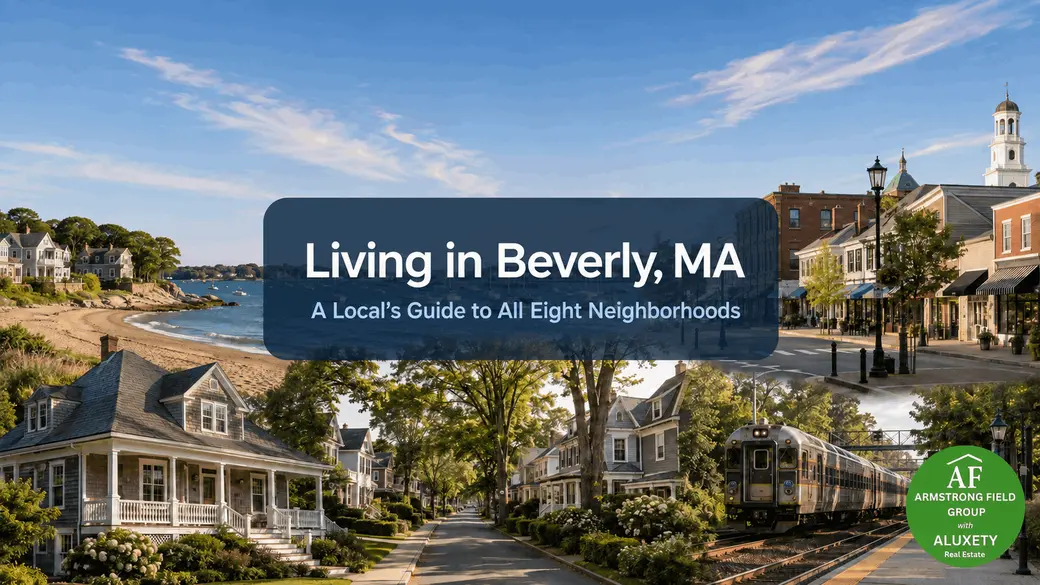
Living in Beverly, Massachusetts: A Local's Guide to Every Neighborhood
I grew up one town over in Danvers, lived in Salem for thirty years, and now call North Beverly home. Here's an honest look at Beverly's eight neighborhoods, the real commute picture, and what buyers and sellers should know before making a move here.
Beverly doesn't get talked about the way Salem or Marblehead do, and honestly, I think that works in its favor. It's a city with real history, a working harbor, eight distinct neighborhoods that each have their own character, and a housing stock that ranges from 17th-century First Period homes to mid-century ranches to new construction near the water. I've sold homes in every one of these neighborhoods, and I still learn something new about this city every year.
This guide is meant to give you the straight version — not a brochure. If you're thinking about buying here, selling here, or you just want to understand where Beverly fits on the North Shore, this is where I'd start.
A Quick History: Older Than the Country It's In
Beverly's story starts in 1626, when Roger Conant led a group of settlers across the Bass River from Salem to what was then called "Bass River Side." It stayed part of Salem for over forty years before being set off and officially incorporated as its own town in 1668, taking its name from Beverley, a market town in Yorkshire, England. It became a city in 1894.
The detail I find most people don't know: Beverly calls itself the "Birthplace of America's Navy." On September 5, 1775, the schooner Hannah — commissioned by George Washington and outfitted at Glover's Wharf — sailed from Beverly Harbor as the first vessel armed for the fledgling American military. You'll still see the Hannah on the city's police department patch today. (Marblehead disputes the claim, for what it's worth — that argument has been going on for two centuries and isn't getting settled here.)
What that history means for buyers in practical terms: Beverly has a genuinely old housing stock in its downtown core and along the harbor, alongside newer neighborhoods further inland. That mix is part of what makes the city interesting, and it's also something to plan around — more on that in the buyer section below.
Beverly's Eight Neighborhoods
Beverly is made up of eight distinct areas, and they don't feel like one another. Knowing which one you're looking at tells you a lot about commute, lot size, housing age, and price point before you even see a listing.
Downtown Beverly (Beverly Depot / Cabot Street)
The commercial and civic heart of the city, built up around the train depot and Cabot Street. Walkable, dense by North Shore standards, with a mix of 19th-century multi-families, converted mill buildings, and condo development near the water. This is the neighborhood for buyers who want to walk to the train, to restaurants, and to Beverly's small but active downtown scene.
Ryal Side
Beverly's westernmost village, bordering Salem across the Bass River — the same river Roger Conant's group crossed in 1626. It's a close-knit, workaday neighborhood of modest single- and two-family homes, with easy access to Route 1A and the Beverly-Salem bridge. A good option for buyers who want proximity to Salem's job base and downtown without paying Salem prices.
Centerville
An inland residential village of mostly single-family homes on quiet, tree-lined streets, roughly between downtown and North Beverly. It doesn't have the water views of the coastal villages, and that's exactly its appeal — larger lots, more square footage per dollar, and easy access to Beverly's schools and municipal facilities.
North Beverly
The city's northernmost inland village, centered around Enon and Dodge Streets, with its own commuter rail stop on the Newburyport branch. This is home for me and my family, so I'll say it plainly: it's a quieter, more suburban stretch of the city, with a mix of mid-century and newer single-family homes on larger lots than you'll find downtown, and easy access north toward Wenham and Hamilton, not to mention Route 128. North Beverly is also where Wenham Lake is located, the largest water reservoir for Beverly and Salem.
The Cove
A tight, historic waterfront neighborhood wrapped around Beverly Harbor's inner cove, walking distance to downtown. Housing here tends to be older and smaller-lot — sea captains' homes, converted fishing shacks, dense residential streets — with harbor views and marina access that larger-lot neighborhoods can't offer.
Montserrat
Named for the ridge it sits on (and shared with Montserrat College of Art, which anchors this part of the city along with nearby Endicott College). It has its own commuter rail stop and a mix of housing ages, from older homes near the tracks to more recently built properties further from the station. A practical, less flashy neighborhood that tends to offer good value relative to the coastal villages.
Beverly Farms
Beverly's northernmost coastal village, and one of its most affluent — large historic estates, mature landscaping, and direct ocean frontage in places, developed originally as a summer colony for wealthy Boston families in the 1800s. It has its own commuter rail station and a small village center with a handful of shops. Lot sizes here run considerably larger than in the rest of the city.
Prides Crossing
Beverly's smallest and most exclusive village, tucked between Beverly Farms and Manchester-by-the-Sea. Historically part of the North Shore's "Gold Coast" of grand summer estates, it remains a neighborhood of large, private waterfront properties with limited turnover. I'll cover an important commute detail specific to Prides Crossing in the next section.
The Honest Commute Picture: Beverly's Branch Split
Commuter rail access is one of the biggest reasons out-of-state buyers give me for looking at Beverly, and I want to give you the accurate version of how it actually works — not the shorthand you'll see in a listing description.
Beverly Depot, downtown, is the junction point. Every train on the MBTA's Newburyport/Rockport Line stops here, and from Beverly Depot the line splits into two separate branches heading in different directions. Which branch serves your neighborhood affects your options, and it's worth understanding before you fall in love with a house.
Newburyport Branch (Eastern Route)
Continues north from Beverly Depot through North Beverly, then on to Hamilton/Wenham, Ipswich, Rowley, and Newburyport. North Beverly station serves this side of the city.
Rockport Branch (Gloucester Branch)
Continues from Beverly Depot to Montserrat, Beverly Farms, then on to Manchester-by-the-Sea, West Gloucester, Gloucester, and Rockport. Montserrat and Beverly Farms stations serve this side.
That's four active stations inside Beverly's city limits, plus Beverly Depot itself — five stations total, which is unusual for a single municipality on this line. Here's the part I think buyers deserve to know up front: Beverly technically has a fifth neighborhood station, Prides Crossing, but it has been closed since 2021 due to low ridership and accessibility limitations, and there's no confirmed timeline for it reopening. If a listing in Prides Crossing markets itself on train access, ask which station residents are actually using day to day — it's very likely Beverly Farms, a car ride away, not a stop in the village itself.
Beyond that detail, I'd encourage any buyer weighing commute time to Boston to check current schedules directly at mbta.com rather than relying on a number I or anyone else quotes you — service patterns and run times shift with MBTA schedule updates, and the difference between an express run and a local can be significant.
What Buyers Should Know About Beverly
Beverly's single-family market has stayed competitive for well-prepared, move-in-ready homes, particularly in Centerville and Ryal Side where inventory tends to turn over more often than in the coastal villages. If you're coming from outside Massachusetts — I work with a fair number of buyers relocating from California and the Midwest — the biggest adjustment is usually the age of the housing stock. A lot of what's on the market downtown, in the Cove, and in Beverly Farms predates 1978, which means a lead paint inspection is worth budgeting for, and older systems (heating, wiring, plumbing) deserve a closer look during inspection than they might in a newer build.
If waterfront or near-water property is part of your search — the Cove, Beverly Farms, and Prides Crossing all have direct water exposure — ask your lender and insurer about flood zone designation early. It affects financing and insurance costs, and it's much easier to plan around before you're under contract than after.
And if commuter rail access matters to your decision, use the branch breakdown above. A house a five-minute walk from Montserrat station and a house in Prides Crossing might be priced similarly, but your actual day-to-day commute could look very different.
What Sellers Should Know About Beverly
If you're selling in one of Beverly's older neighborhoods — downtown, the Cove, Ryal Side — documented history adds real value. Buyers here respond to knowing a home's age, any notable past ownership, and what's been preserved versus updated. If your home has original details or you know its build date, that's worth pulling together before you list, not after an offer comes in.
For homes in Beverly Farms or Prides Crossing, the story shifts toward privacy, land, and water access — buyers at that price point are typically less concerned with walkability to downtown and more focused on lot size, frontage, and the quality of recent capital improvements (roof, seawall, heating systems). Documentation of those improvements matters as much as the improvements themselves.
Across every neighborhood, the same basic rule applies: Beverly buyers are savvy about which village they want and why. A home that's honestly priced and clearly presented for its specific neighborhood — rather than marketed as generically "North Shore" — tends to move faster and with fewer surprises during negotiation.
A Note on Timing and Verification
Market conditions, MBTA schedules, and flood zone maps all change. The neighborhood and transit information in this guide is accurate as of publication, but if you're making a decision based on commute time, insurance costs, or current pricing in a specific Beverly neighborhood, I'd rather walk you through the current numbers directly than have you rely on anything general you read online — including this post.
Reach out any time for a neighborhood-specific market snapshot before you make a decision.
Beverly, MA: Frequently Asked Questions

Thinking About Beverly?
Whether you're weighing neighborhoods as a buyer or getting ready to list, I'm happy to walk through the specifics of your situation — no pressure, just straight answers.
Categories
- All Blogs (202)
- Beverly, MA (14)
- Buying a Home (98)
- Condos For Sale (7)
- Danvers, MA (2)
- Estates & Inherited Homes (3)
- Gloucester, MA (1)
- Home Ownership (49)
- Home Sellers Guide (20)
- Homes For Sale (10)
- Ipswich, MA (2)
- Jim Armstrong (1)
- Landlords (1)
- Living on the North SHore (31)
- Mortgages (16)
- Peabody, MA (2)
- Prospective Real Estate Agents (1)
- Real Estate Careers (7)
- Real Estate Market Conditions (44)
- Real Estate School (2)
- Renting (1)
- Salem, MA (15)
- Selling a home (104)
- Senior Living (2)
- Swampscott, MA (1)
Recent Posts