

Oil Heat on the North Shore: What Buyers and Sellers Need to Know
Oil Heat on the North Shore: What Buyers and Sellers Need to Know
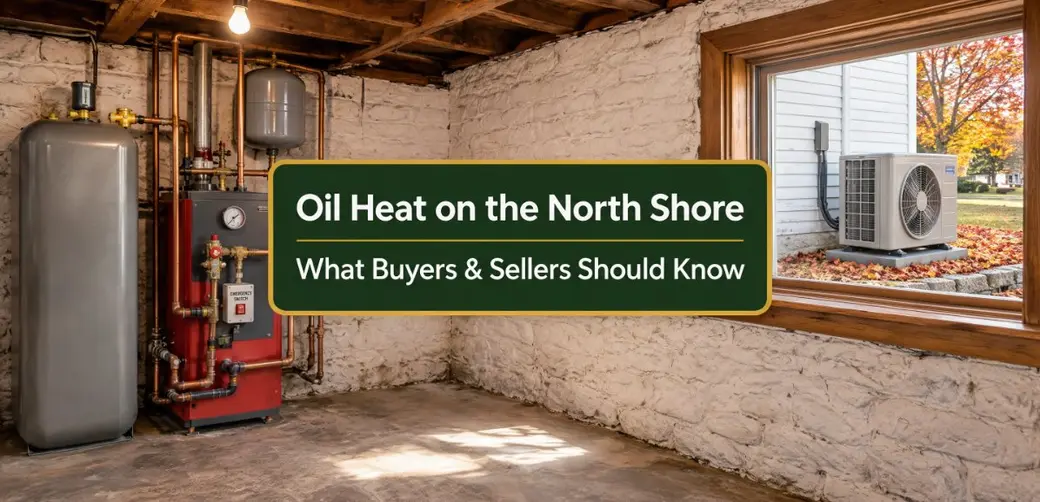
Every November I hear the same question from buyers touring older homes on the North Shore: "Is oil heat a problem?" It usually comes up in a basement in Salem or Beverly, standing next to a tank that's been there longer than anyone in the room can remember.
The short answer is no, oil heat by itself isn't a problem. Plenty of well-kept antique colonials and mid-century capes across Essex County still heat with oil, and they sell every year. What causes trouble is not knowing the condition of the tank and the lines, not knowing whether the system meets Massachusetts law, and not knowing what your insurance actually covers. Those are all things you can find out before you sign anything.
Here's what I walk my buyers and sellers through, and where my GREEN designation and more than 25 years of North Shore deals come in handy.
How common is oil heat in Massachusetts?
More common than many newcomers expect. Roughly 650,000 Massachusetts homes, about a quarter of the state, heat with fuel oil, according to figures from the state Department of Energy Resources reported by MassLive. If you're relocating from California or the Midwest, where natural gas and electric heat are the norm, an oil tank in the basement can feel strange at first. It's normal here, especially in older housing stock. (If you're making that move, our North Shore Relocation Guide covers more of these regional differences.)
The Massachusetts oil heat law, in plain English
Massachusetts passed a homeowner oil heating law in 2008 (Chapter 453 of the Acts of 2008, amended in 2010) after years of costly basement spills. For one- to four-unit homes heated with oil, it requires one of two leak-prevention upgrades: an oil safety valve at the tank end of the supply line, or a supply line enclosed in a continuous non-metallic protective sleeve. The work has to be done by a licensed oil burner technician. There's an exemption when the burner sits above the tank and the entire supply line connects to and runs above the top of the tank.
According to MassDEP's fact sheet on the law, these upgrades typically cost in the low hundreds of dollars. Compared with a cleanup bill, that is cheap insurance.
The second half of the law deals with insurance, and this is the part most homeowners miss.
Under the 2008 law, insurers that write homeowners policies must offer coverage for oil leaks to homes that meet the upgrade requirement. MassDEP's fact sheet describes first-party cleanup coverage of at least $50,000. But it's an optional add-on, and you generally have to ask for it.
A 2022 WGBH report found only about 7% of oil-heated homes carried that coverage. Bills to make it automatic have been filed at the State House in recent sessions, but as of this writing the coverage is still something you have to request. One phone call to your insurance agent answers it.
If you're buying a home with oil heat
Oil heat shouldn't scare you off a house you love, but it should shape your due diligence. Start by finding out where the tank is and how old it is. A tank in the basement is easy to see and inspect. A buried tank in the yard is a different conversation. Signs of a possible underground tank include a fill pipe or vent pipe sticking up out of the lawn, or capped copper lines running through the foundation wall. If you see any of those, ask about them in writing.
Next, ask the seller for service records and the tank's installation date, and confirm the safety valve or sleeve is in place. Your home inspector will look at the system, but a dedicated heating technician or tank specialist can give you a better read on an older setup.
Then get your homeowners insurance quote during your inspection period, not the week before closing. Some insurers and lenders take a hard line on buried tanks, and you want to learn that while you still have options. Ask the agent directly about oil-leak coverage while you're on the phone.
This is the kind of thing we map out at a buyer consultation, before you're standing in a basement trying to make a decision on the spot. If you're new to all of this, our interactive first-time buyer guide lays out the whole timeline, and you can browse current North Shore listings to see what's on the market.
If you're selling a home with oil heat
The best thing a seller can do is get ahead of the buyer's questions. Pull together your service records, the tank's age, and proof that the leak-prevention upgrade is in place. If your tank is near the end of its life, replacing it before you list can take an objection off the table. Many local oil companies and heating contractors handle this, and I'm glad to share names of people my clients have used.
If there's a buried tank on the property, talk with me and with your attorney early. In my experience, an underground tank can complicate a buyer's financing and insurance, and many sellers choose to have it properly removed before listing rather than negotiate around it mid-deal. Removal requires local fire department permits, so check with your town's fire prevention office about what it needs.
Massachusetts is generally a "buyer beware" state, but that doesn't give sellers permission to mislead. If a buyer asks about the tank, answer honestly, and talk with your attorney about anything you're unsure of. I'm a REALTOR®, not a lawyer, and this isn't legal advice.
Curious how your home's heating system might factor into pricing? Start with a free home value estimate, then use our seller net proceeds calculator to see what a tank replacement or removal would do to your bottom line.
Heat pumps: worth a look, not a requirement
There's no rule that says you have to convert from oil to sell or buy a home in Massachusetts. Still, many buyers ask about heat pumps, and the rebates are real. I switched my home from oil heat to heat pumps (mini-splits) in 2015, and have not regretted it. For 2026, Mass Save lists a whole-home air source heat pump rebate of $2,650 per ton, up to $8,500, with higher income-based incentives (up to $16,000) for households that qualify. Whole-home rebates require the house to be adequately weatherized first, which is often where older North Shore homes need the most work.
Two timing notes. The federal tax credit that used to stack on top of these rebates expired at the end of 2025. And Mass Save has already posted that partial-home heat pump rebates drop for projects installed on or after January 1, 2027. If you're on the fence about a partial conversion, that's worth a conversation with an installer this winter.
For antique homes, ductless mini-splits are often the practical route since they avoid tearing into historic plaster for ductwork. A Mass Save home energy assessment is a good, low-cost first step either way.
The bottom line
An oil-heated home on the North Shore can be a great home. Buyers should know where the tank is, what shape it's in, and what their insurance covers. Sellers should have their paperwork ready and deal with any buried tank early. And anyone curious about heat pumps should look at the 2026 rebates sooner rather than later. If you'd like a second set of eyes on a specific house, give me a call.
Frequently Asked Questions

Search North Shore Listings What's My Home Worth? Seller Net Proceeds Calculator First-Time Buyer Guide North Shore Relocation Guide Buyer Guides
Categories
- All Blogs (207)
- Beverly, MA (14)
- Buying a Home (101)
- Condos For Sale (7)
- Danvers, MA (2)
- Estates & Inherited Homes (3)
- Gloucester, MA (1)
- Home Ownership (50)
- Home Sellers Guide (20)
- Homes For Sale (10)
- Ipswich, MA (2)
- Jim Armstrong (1)
- Landlords (1)
- Living on the North SHore (31)
- Mortgages (16)
- Peabody, MA (2)
- Prospective Real Estate Agents (1)
- Real Estate Careers (7)
- Real Estate Market Conditions (45)
- Real Estate School (2)
- Renting (1)
- Salem, MA (15)
- Selling a home (109)
- Senior Living (2)
- Swampscott, MA (1)
Recent Posts