
Can AI Really Replace Your Real Estate Agent?
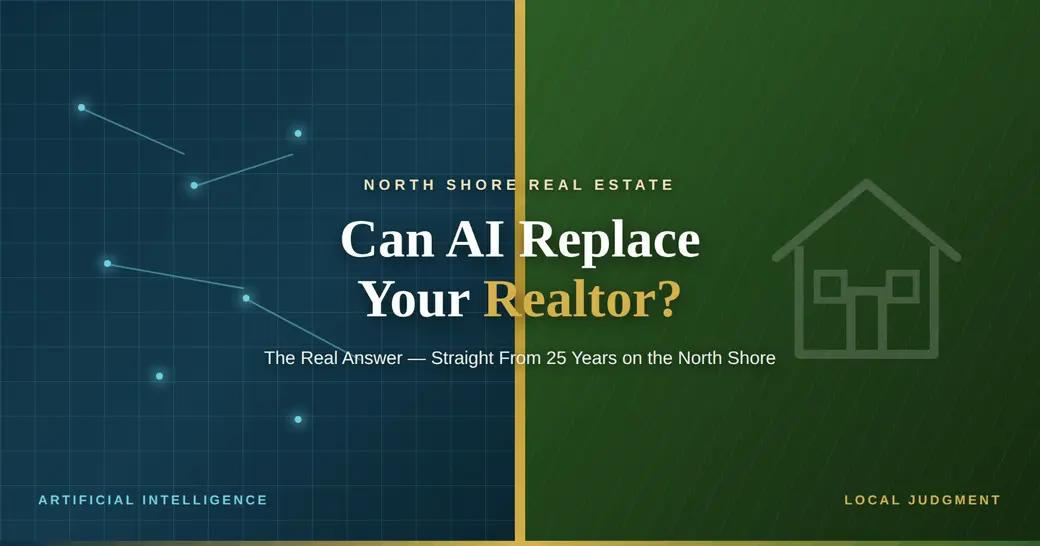
Can AI Really Replace Your Real Estate Agent?
What ChatGPT, Zestimates, and automated valuation tools get right — and where they run into trouble on the North Shore's historic and coastal housing stock.
Source: National Association of REALTORS®, 2025 Profile of Home Buyers and Sellers
It comes up more and more in listing appointments. A seller will mention that a friend used ChatGPT to write their listing description, or that Zillow's Zestimate seems close enough, or that they figure they can just handle it themselves this time. It's a fair question in 2026, and I'd rather answer it directly than pretend it isn't being asked.
Here's the honest version: AI is genuinely useful for some parts of selling or buying a home. It's just not useful for the parts that actually determine whether you get the outcome you want.
Where AI Genuinely Helps
I use these tools myself, and I'll say so plainly. A first draft of a property description, a quick summary of recent sales trends, a fast estimate of a home's rough value range — AI can produce all of that in seconds. For someone doing basic research before they've even decided to sell, that's a real time-saver, and there's no reason to pretend otherwise. But like most AI answers, it has to be reviewed for accuracy and legal compliance by a knowledgable human.
The trouble is that all of those tasks happen before anyone has walked through the front door. The moment a buyer stands in the kitchen, or an inspection turns up something unexpected, or an offer comes in $15,000 under asking with a 10-day close, the tool goes quiet. That's where the actual work of a real estate transaction begins.
Where It Runs Into Trouble on the North Shore
Historic and antique housing stock. A lot of our inventory in Salem, Beverly, Danvers, and the surrounding communities predates automated valuation models by a couple hundred years. Post-and-beam framing, hand-hewn detail, additions built in three different centuries, non-conforming lot configurations, local historic district review — none of that fits neatly into an algorithm trained mostly on tract housing and standardized floor plans. National AVMs are built on comparable-sales math, and antique North Shore homes routinely break that math because there's often no truly comparable sale nearby.
Waterfront and coastal properties. Seawall condition, erosion history, flood zone designation, deeded beach rights, dock access — these details carry real weight in value and in whether a deal closes cleanly, and none of them show up in a generic online estimate. I've seen automated valuations swing wildly on coastal parcels because the tool has no way to weigh what's actually happening at the water's edge.
Estate and probate sales. These transactions involve court timelines, multiple heirs who may not agree with each other, personal property that needs to be sorted, and a family working through loss while also trying to make financial decisions. No chatbot manages that. It takes patience, clear communication, and someone who has actually walked families through this process before.
Local, street-level market knowledge. What's happening in downtown Beverly this month is not necessarily what's happening in Danvers or Peabody, even though they're a few miles apart. Micro-market timing, what buyers are actually responding to right now, which price point is drawing multiple offers versus sitting — that kind of granular, current knowledge comes from being active in these specific towns, not from a model trained on national averages.
What Happens When Sellers Rely on the Estimate Alone
This is a pattern I see fairly often, not tied to any one property: a seller pulls an online estimate for a 1800s Colonial or a converted carriage house, and the number is off by a wide margin — sometimes too high because the tool weighted square footage without accounting for a layout that doesn't work for modern buyers, sometimes too low because it couldn't account for original woodwork, a renovated kitchen, or a walk to the harbor. Either way, a seller anchored to that number can end up pricing the home wrong out of the gate, which costs time on market and, often, money at closing.
What the Data Says About Going It Alone
According to the National Association of REALTORS®' 2025 Profile of Home Buyers and Sellers, a record 91% of sellers nationally used a real estate agent last year, while For Sale By Owner transactions fell to an all-time low of just 5%. The gap in outcome is significant: FSBO homes sold at a median price of $360,000, compared to $425,000 for agent-assisted sales — a difference of roughly $65,000. Sellers who worked with an agent also sold, on a national median basis, closer to full asking price and typically moved through the process faster than those who went it alone.
That data doesn't mean every seller needs an agent to succeed. It does suggest that most people who've tried the alternative learned something valuable about where the real complexity in a transaction actually lives.
What You're Actually Paying For
The value isn't the listing description or the initial number. It's the judgment that comes from having done this hundreds of times: knowing which repairs actually move the needle before listing, how to price a property that doesn't have a clean comp, how to keep a deal together when an appraisal comes in low or an inspection turns up a surprise, and how to negotiate toward a result that actually works for you rather than just toward "a deal."
It's also accountability. When something goes sideways at 9 p.m. two days before closing, a tool doesn't answer the phone. I do, and so does the rest of the Armstrong Field Group — our team is structured so there's always someone available, which matters most exactly when things get stressful.
My grandmother, Lillienne Field, opened Field Real Estate in Salem in 1944 and became the first woman appointed to the local Board of Realtors. She built her reputation on honesty and follow-through in an industry that didn't always make room for that. Twenty-five years into doing this work myself, across historic sales, waterfront properties, and more estate transitions than I can count, that's still the piece that technology hasn't touched: someone who knows this market, stays level when things get hard, and is accountable for the outcome.
If you're weighing whether to sell or buy on your own versus working with someone who knows the North Shore in detail, I'm glad to walk through your specific situation — no pressure, no script.
Frequently Asked Questions
Can I really sell my North Shore home without an agent using AI tools?
You can, and a small percentage of sellers do. But national data from 2025 shows only 5% of sales went this route, and those homes sold for a median of $65,000 less than agent-assisted sales. AI tools can help with drafts and quick research, but they can't price, market, negotiate, or manage a closing timeline the way an experienced local agent can.
Why don't online home value estimators work well for historic North Shore homes?
Automated valuation models rely heavily on recent comparable sales with similar, standardized features. Antique and historic homes in Salem, Beverly, and Danvers often have unique construction, additions, and layouts that don't have a true match nearby, which can throw the estimate off in either direction.
What can an AI-generated listing description miss about my property?
AI can produce a serviceable draft, but it doesn't know the story of your home — original details worth highlighting, why a particular room or view matters to buyers, or how to frame a quirky layout as a feature rather than a flaw. Those judgment calls come from experience with how North Shore buyers actually respond.
Is AI making real estate agents obsolete?
Not based on current data. A record 91% of sellers still used an agent in 2025, up from the year before. AI is changing which tasks agents spend time on, but the parts of a transaction that require judgment, negotiation, and accountability still require a person.
How does an agent add value during negotiations that AI can't?
Negotiation involves reading people, understanding leverage in the moment, and making real-time decisions when an offer, inspection result, or appraisal changes the picture. That requires judgment built from experience, not a set of pre-programmed responses.
What should I look for in an agent if AI tools are already doing so much of the work?
Look for someone with deep knowledge of your specific towns, a track record with your type of property (historic, waterfront, estate/probate, etc.), and a team structure that means you're never without support during a time-sensitive moment.

Not Sure What Your Home Is Actually Worth?
Online estimates are a starting point, not an answer — especially on the North Shore's historic and coastal housing stock. Let's talk through what your property is really worth in today's market.
Get a Real Market AnalysisCategories
- All Blogs (199)
- Beverly, MA (13)
- Buying a Home (96)
- Condos For Sale (7)
- Danvers, MA (2)
- Estates & Inherited Homes (3)
- Gloucester, MA (1)
- Home Ownership (49)
- Home Sellers Guide (20)
- Homes For Sale (10)
- Ipswich, MA (2)
- Jim Armstrong (1)
- Landlords (1)
- Living on the North SHore (31)
- Mortgages (16)
- Peabody, MA (1)
- Prospective Real Estate Agents (1)
- Real Estate Careers (7)
- Real Estate Market Conditions (44)
- Real Estate School (2)
- Renting (1)
- Salem, MA (15)
- Selling a home (103)
- Senior Living (2)
- Swampscott, MA (1)
Recent Posts