

What Do Appraisal Condition Ratings C1–C5 Actually Mean?
What Do Appraisal Condition Ratings C1–C5 Actually Mean — And Can They Sink Your Financing?
A plain-English guide to how appraisers grade your home's condition, and why it matters more than most buyers and sellers on the North Shore realize.
If you've bought or sold a home with a conventional mortgage anywhere in the country over the last several years, an appraiser looked at your property and quietly assigned it a letter-and-number grade you probably never saw: a condition rating between C1 and C6. Most people never think about this rating until it shows up in the middle of a transaction and threatens to derail the loan.
On the North Shore, where we have a lot of wonderful older homes — 1700s and 1800s colonials in Salem and Beverly, farmhouses in Danvers, capes and antique homes throughout Essex County — this comes up more often than you'd think. So let's walk through what these ratings actually mean, how they're assigned, and what a C4 or C5 rating can do to your financing.
Where These Ratings Come From
The condition rating system comes from Fannie Mae's Uniform Appraisal Dataset, usually just called the UAD. Appraisers use it on most conventional loan appraisals so that lenders, underwriters, and secondary market investors are all working from the same definitions instead of an appraiser's personal opinion of "pretty good shape."
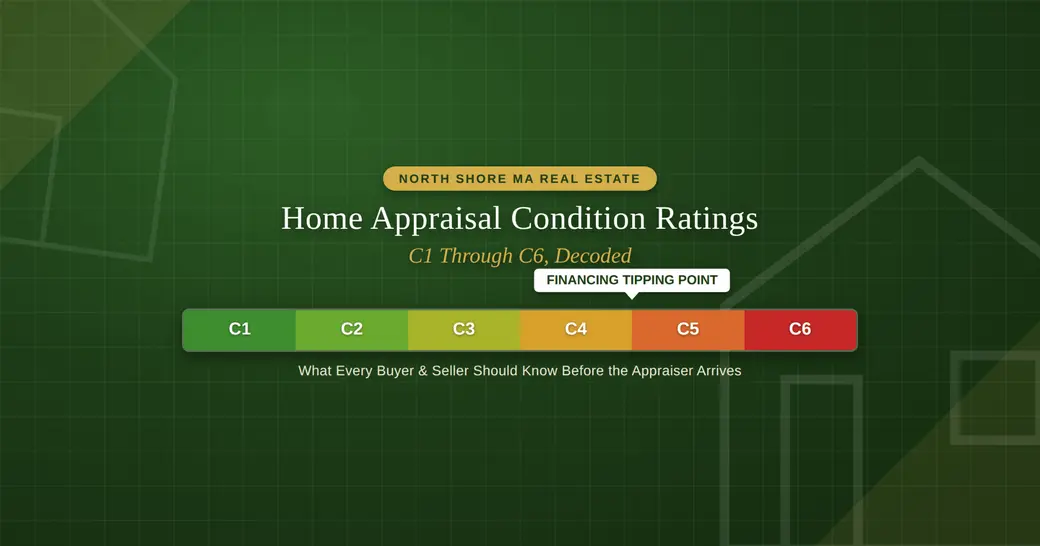
The scale runs from C1 to C6, with C1 representing a brand-new, never-occupied home and C6 representing a property with serious deficiencies that affect safety or structural integrity. The appraiser assigns this rating holistically, looking at the home's major systems and components as a whole rather than grading each room separately.
The Condition Ratings, Explained
How a C4 or C5 Rating Affects Your Financing
This is the part that catches buyers and sellers off guard, because it's rarely discussed until an appraisal comes back and a loan officer starts making phone calls.
C4 usually isn't a dealbreaker. It's a common, unremarkable rating for an older, honestly maintained home — which describes a good share of the housing stock in Salem, Beverly, and Danvers. Most conventional loans, and many government-backed loans, can close on a C4 property without requiring repairs. The lender simply underwrites the loan knowing the home is in average, lived-in condition.
C5 is where things get harder. Fannie Mae and Freddie Mac both treat a C5 (and C6) rating as a red flag for loan eligibility, and their requirements aren't identical — which is exactly why this needs to be confirmed with your specific lender rather than assumed. In general, expect one of two outcomes on a C5 property: the lender requires specific repairs to be completed before closing so the home can be re-rated to at least a C4, or the loan simply isn't eligible to be sold to that particular investor as-is, which can push the buyer toward a different loan product, a larger down payment, or a renovation loan that finances the repairs as part of the mortgage.
The Bottom Line for Sellers
If your North Shore home has an aging roof, an original heating system, or other age-related wear, don't panic — a C4 rating is common and rarely stops a sale. But if you suspect your home could land at C5 (major systems failing, visible structural concerns, significant deferred maintenance), it's worth addressing before you list, or at least being ready to price and market the home accordingly. A pre-listing inspection can flag these issues early, while you still have time and options.
A Note on Historic Homes
One thing worth understanding if you're buying or selling a historic property here: age alone doesn't determine the rating. An appraiser is looking at the condition of the systems and components, not the year the house was built. A well-maintained 1820s home with an updated heating system and a newer roof can still land at C3. The original wide-plank floors, historic moldings, and period details that make these homes special aren't what pulls the rating down — deferred maintenance on the systems behind the walls is.
What Buyers Should Take Away From This
If you're under agreement on a North Shore home and the appraisal comes back with a C4 or lower, don't assume the deal is dead. Talk to your loan officer right away. Ask specifically what condition rating was assigned, what (if anything) it requires before closing, and whether your loan program has flexibility. In many cases, a C4 simply means you're buying a house that's been lived in — which describes most of the housing stock in our older North Shore towns.
Frequently Asked Questions
What is a property condition rating on an appraisal?
It's a standardized grade, C1 through C6, that appraisers assign under Fannie Mae's Uniform Appraisal Dataset (UAD) to describe a home's overall physical condition. It ranges from new construction (C1) to homes with serious safety or structural deficiencies (C6).
What's the difference between a C3 and a C4 rating?
A C3 home is well maintained with minimal wear and no deferred maintenance. A C4 home is livable and functional but has identifiable maintenance items — like an aging roof or original heating system — that a buyer would reasonably expect to address over time.
Can you get a mortgage on a home with a C5 rating?
It's possible, but harder. Fannie Mae and Freddie Mac both apply extra scrutiny to C5 properties, and requirements vary by lender and investor. In many cases, the lender will require specific repairs before closing to bring the home up to at least a C4, or the buyer may need a different loan product.
Does a lower condition rating always mean a lower appraised value?
Not necessarily in a direct, formulaic way — condition and value are related but separate parts of the appraisal. A C4 or C5 rating reflects the home's physical condition, while the appraiser still analyzes comparable sales to arrive at value. That said, condition issues can influence which comparables are used and what adjustments are made, so the two are connected.
Will my historic North Shore home automatically get a lower condition rating because of its age?
No. Appraisers rate the condition of a home's systems and components, not its age. A historic home with updated mechanical systems and no deferred maintenance can still receive a C3. It's the condition of what's behind the walls — not the year built — that drives the rating.
What should sellers do if they're worried about a C4 or C5 rating?
Start with a pre-listing inspection so you know where things stand before a buyer's appraiser does. Address anything that could be flagged as significant deferred maintenance, and keep documentation of past repairs and upgrades handy — it gives the appraiser evidence to support a stronger rating.
Related Reading & Resources

Wondering How Your Home Would Rate?
If you're thinking about selling a North Shore home — especially an older or historic one — I can walk through your property, flag anything that could affect an appraisal, and help you prepare before you ever list.
Request Your Free Home ValuationCategories
- All Blogs (199)
- Beverly, MA (13)
- Buying a Home (96)
- Condos For Sale (7)
- Danvers, MA (2)
- Estates & Inherited Homes (3)
- Gloucester, MA (1)
- Home Ownership (49)
- Home Sellers Guide (20)
- Homes For Sale (10)
- Ipswich, MA (2)
- Jim Armstrong (1)
- Landlords (1)
- Living on the North SHore (31)
- Mortgages (16)
- Peabody, MA (1)
- Prospective Real Estate Agents (1)
- Real Estate Careers (7)
- Real Estate Market Conditions (44)
- Real Estate School (2)
- Renting (1)
- Salem, MA (15)
- Selling a home (103)
- Senior Living (2)
- Swampscott, MA (1)
Recent Posts