
What It Really Costs to Sell a Home on the North Shore in 2026
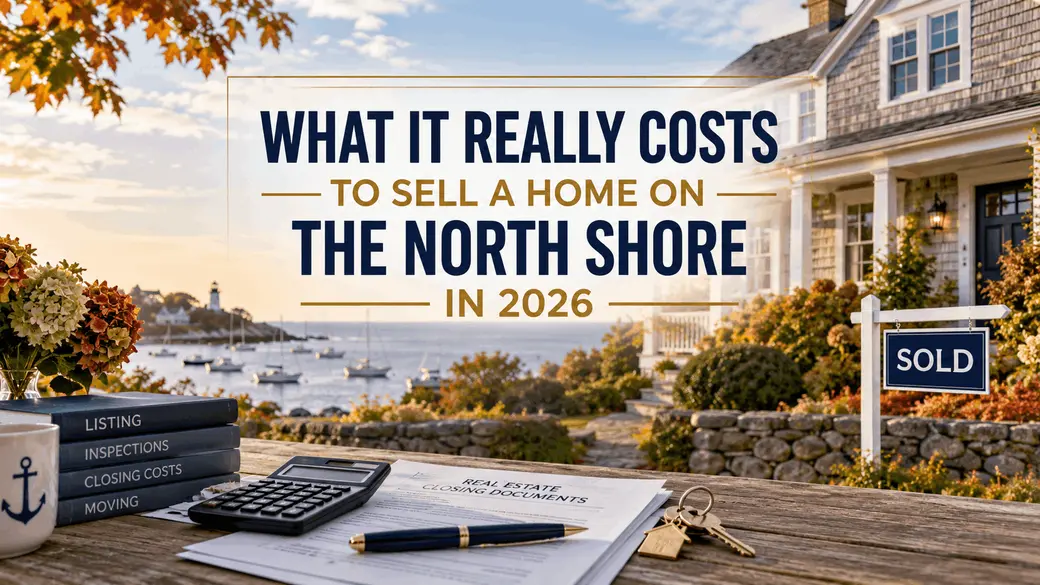
What It Really Costs to Sell a Home on the North Shore in 2026
Every seller I sit down with asks some version of the same question, usually about ten minutes in. They ask it a little sheepishly, like it's impolite. It isn't. It's the only question that matters:
"So what do I actually walk away with?"
It is genuinely hard to find a straight answer to that online. Most of what's published about selling costs is written for a national audience, which means it skips the things that make Massachusetts different — the excise tax, the mandatory attorney, the fire department certificate you can't close without. And most of what's written locally treats commission like a state secret.
So here is the whole thing, line by line. What's fixed by Massachusetts law, what's negotiable, what depends on your particular house, and roughly what the total looks like on a typical North Shore sale. I've been doing this here since 2000, and I'd rather you walk into a listing appointment already knowing the numbers than find them out one uncomfortable line at a time.
Start with net, not gross
The first mental shift is the useful one. Sale price is a headline number. Net proceeds — what hits your account after everything comes out — is your actual number, and it's the one you should be planning your next move around.
Between those two numbers sit four buckets: your mortgage payoff, the brokerage fees you negotiate, the Massachusetts transaction costs that apply to essentially every sale, and the property-specific costs that depend on what you own and where. Only one of those four is genuinely negotiable, which is worth knowing before you spend a lot of energy on the wrong one.
If you want to run your own numbers while you read this, our home seller net proceeds calculator will do the arithmetic for you. Plug in a sale price and your payoff and you'll have a working estimate in about a minute — then use the rest of this article to understand what each line actually is and where yours might differ.
Sellers spend hours negotiating the one cost that's negotiable and almost no time on the prep decisions that move the sale price by ten times as much.
How commissions actually work now
This changed in August 2024 and a lot of sellers still have the old model in their heads, so it's worth being precise.
Under the rule changes that took effect August 17, 2024 as part of the National Association of REALTORS® settlement, buyer-agent compensation is no longer advertised through the MLS, and buyers must sign a written agreement with their agent, spelling out that agent's compensation, before they tour homes. Those two changes unhooked the two sides of the fee from each other.
What that means for you as a seller, practically:
You negotiate one fee with your listing brokerage. There is no standard rate. There never legally was one, but the old MLS mechanics made it feel that way. Rates are set by each brokerage independently and are negotiable between you and the agent you hire.
Separately, you decide whether to offer a buyer-agent concession. This is a credit at closing that covers some or all of the buyer's agent fee. You're not required to. Most sellers still do — a Zillow survey found roughly 72% of closed transactions in early 2026 still involved the seller paying some or all of the buyer's agent fee — because a buyer who has to come up with their agent's fee in cash on top of their down payment may simply skip your house for one where they don't.
That's the real calculus now. It isn't a moral question or a rules question. It's a question of how wide you want your buyer pool to be, and it should be decided with your specific property, price point, and timeline in front of you. A waterfront property in Manchester with a narrow buyer pool and a well-priced condo in downtown Salem are not the same decision.
The more useful question than "what's the rate" is "what am I getting for it." Pricing strategy, prep guidance, photography, how offers get handled, who answers the phone when something goes sideways two days before closing. I'd encourage you to ask any agent you interview to walk you through exactly what's included, in writing. If you want a sense of how we approach it, that's what the seller consultation and home valuation conversation is for, and it costs nothing to have it.
The Massachusetts costs that apply to nearly every sale
Deed excise tax (the "tax stamps")
Massachusetts charges a deed excise tax on real property transfers under M.G.L. Chapter 64D. The rate is $4.56 per $1,000 of the sale price — technically $2.28 per $500. It's flat. There are no tiers and no mansion-tax threshold, and Essex County uses the statewide rate. On an $850,000 sale, that's $3,876.
By long-standing custom the seller pays it. Like most closing costs it's technically negotiable, and in a strong market a buyer will occasionally offer to cover it as a sweetener, but plan on it being yours.
Your attorney
Massachusetts requires a licensed attorney to conduct a real estate closing. This is not optional and it's not a regional custom — it's how closings work here. The buyer's lender has its own closing attorney; you'll want your own counsel reviewing the purchase and sale agreement and representing your side.
Published statewide ranges for seller-side representation run roughly $800 to $3,000. On a straightforward North Shore single-family sale you're generally toward the lower half of that; estates, trusts, title issues, and properties with complicated ownership history run higher because they take more work.
The smoke and carbon monoxide certificate
This is the one that derails closings, and it's entirely avoidable.
Under M.G.L. Chapter 148, Section 26F, you cannot transfer a one- or two-family home in Massachusetts without a certificate of compliance from your local fire department confirming your smoke and CO alarms meet code for your home's age. No certificate, no closing.
State law caps the fee at $50 for a single-family dwelling or single unit, $100 for a two-family, $150 for buildings with six or fewer units, and $500 for more than six. Salem's fee schedule matches those figures exactly, and Beverly charges $50 per dwelling unit. If the smoke and CO inspections are done at the same time, you can't be charged a second fee for the CO inspection.
Two local details worth knowing. First, Beverly does not accept ionization alarms — they won't pass inspection there even though they're sold at every hardware store in town. Photoelectric only. Second, fire departments book out, sometimes weeks, and the spring and summer market is the worst time to discover that. Schedule it early. How long a certificate stays valid varies, so confirm the window with your department rather than assuming.
Every seller I work with gets this handled well before we're near a closing date, because $50 turning into a two-week delay is the most expensive fifty dollars in the transaction.
Recording fees, discharges, and prorations
Small but real. Recording your mortgage discharge at the Registry of Deeds, any municipal lien certificate, a final water and sewer read, and prorated property taxes. Massachusetts assesses property taxes on a fiscal year running July 1 to June 30, and bills are paid in arrears, which means depending on your closing date you may owe a proration or receive a credit. Your attorney calculates all of this. Budget a few hundred dollars and let the settlement statement tell you the rest.
Costs that depend on what you own
Selling a condo: the 6D certificate
If you're selling a condominium, you'll need a 6D certificate — named for Section 6(d) of the Massachusetts Condominium Act, M.G.L. Chapter 183A. It's a statement from your association confirming whether you owe anything in common fees, special assessments, or fines.
It matters because the association holds a lien on your unit for unpaid common expenses, and a clean 6D discharges it. Without one, that lien can follow the unit to the new owner, which is why no lender or closing attorney will proceed without it.
Association processing fees typically run somewhere between $50 and $500 depending on the management company, with rush service costing more. The seller customarily pays. By statute the association has to issue it within 10 business days of a proper written request and fee, but in practice one to three weeks is normal and small self-managed buildings can take longer. Order it early. This is one of the most common causes of a condo closing slipping by a week.
Selling a home on septic: Title V
If your property is on a septic system rather than town sewer, Massachusetts requires a Title V inspection before the transfer. Typical inspection cost runs roughly $400 to $900 depending on the system and how accessible it is.
The inspection itself is a modest expense. The risk is what it finds. A failed system has to be repaired or replaced before closing, and a full replacement commonly runs $20,000 to $50,000 or more depending on the system, the soil, and the lot. Some Massachusetts municipalities offer betterment programs that let the cost be assessed to the property and paid over a period of years, which can change the math considerably — worth asking your town about specifically.
If you're on septic and you're thinking about selling in the next year or two, getting the inspection done on your own timeline rather than under a closing deadline is one of the highest-value things you can do. You find out what you're dealing with while you still have options.
Older homes and lead paint
A lot of what makes North Shore housing stock appealing is also what makes it old. If your home was built before 1978, federal law requires lead paint disclosure as part of the sale, and Massachusetts has its own lead law with its own requirements. This is an area where your attorney's guidance matters more than mine, and it's worth raising with them early if you've never dealt with it. We handle a lot of historic and antique properties here and this comes up constantly.
The costs before you ever list
These are the discretionary ones, and they're where sellers most often either overspend or underspend badly.
Depending on the property, you might be looking at professional photography, staging or partial staging, a deep clean, storage for excess furniture, landscaping and exterior cleanup, painting, and any targeted repairs. On some listings that's a few hundred dollars. On others it's several thousand, and occasionally it should be more than that.
The honest answer is that this number is completely property-specific, and the value an agent adds here is largely subtractive: telling you what not to spend money on. I've walked into plenty of homes where the owner was ready to put $30,000 into a kitchen that didn't need it, when $4,000 of paint, light fixtures, and decluttering would move the number just as far. I've also walked into homes where the roof genuinely had to be addressed before we listed.
That's what a pre-listing walkthrough is for, and we do them at no cost precisely because guessing here is expensive. You can see how comparable homes are currently being presented on the market, which is usually clarifying on its own.
Putting it together: an illustrative net sheet
Here's what the fixed side looks like on a hypothetical $850,000 single-family sale in Beverly. To be clear, these are illustrative figures for a straightforward transaction — your actual numbers depend on your property, your payoff, and what you negotiate.
| Line item | Estimated |
|---|---|
| Sale price | $850,000 |
| MA deed excise tax ($4.56 per $1,000) | − $3,876 |
| Seller-side attorney | − $800–$2,500 |
| Smoke & CO certificate (Beverly, single family) | − $50 |
| Recording, discharge, municipal lien certificate | − $100–$400 |
| Title V inspection (septic properties only) | − $400–$900 |
| 6D certificate (condominiums only) | − $50–$500 |
| Prep, staging, photography | varies widely |
| Brokerage fee | as negotiated |
| Buyer-agent concession, if offered | as negotiated |
| Prorated taxes, final water & sewer | closing-date dependent |
| Mortgage payoff | your balance |
| Fixed Massachusetts costs on this example | roughly $4,800–$6,800 |
So on an $850,000 North Shore sale, the non-negotiable Massachusetts side of the ledger lands somewhere around five to seven thousand dollars before a single dollar of brokerage fee or prep cost enters the picture. That's the part almost nobody budgets for, and it's the part I'd rather you hear from me in March than from a settlement statement in June.
To run this with your own sale price and mortgage balance rather than my hypothetical, use the
Seller Net Proceeds Calculator.
It's free, there's nothing to sign up for, and the output is yours to keep whether we ever speak or not.
Want your actual numbers instead of a hypothetical?
A seller net sheet takes about twenty minutes to put together once I know your property, your approximate payoff, and your timeline. No obligation, no pressure, and you keep it whether or not you ever list with us.
Prefer to do it yourself first? The net proceeds calculator will get you a solid estimate in a minute.
One rule change that affects your budget indirectly
Since October 15, 2025, under regulations adopted as part of the 2024 Affordable Homes Act, sellers and their agents in Massachusetts can no longer condition acceptance of an offer on a buyer waiving or limiting a home inspection, and cannot accept an offer knowing the buyer intends to waive one. There's also a required disclosure form that should be part of your listing package from the first showing.
This doesn't add a line to your closing statement, but it does change your planning. The waived-inspection offers that were common a few years ago are largely gone, which means essentially every deal now includes an inspection and a possible repair negotiation. Build a cushion into your expectations for that. It's another argument for a pre-listing inspection: knowing what a buyer's inspector will find, before they find it, is the difference between managing a negotiation and reacting to one.
The cost that dwarfs all of these
I'll be direct, because it's the most useful thing in this article.
Every number above is measured in hundreds or low thousands of dollars. Pricing your home wrong is measured in tens of thousands, and it's the cost sellers pay most often. An overpriced listing sits, accumulates days on market, and eventually sells for less than it would have if it had been priced correctly from the start — after months of showings and a price reduction that signals weakness to every buyer watching.
Condo and single-family conditions on the North Shore have not been moving in lockstep, and they differ town by town. What Beverly is doing is not what Gloucester is doing. Getting that read right is worth more than every line item on the net sheet combined.
And if you're selling in order to buy something else — which describes most of the people I work with — the two sides need to be planned together, not sequentially. That's a longer conversation, and the buyer consultation is where it usually starts. If your next move is a first purchase for someone in your family, the Massachusetts buyer programs page is a reasonable place to begin.
Frequently asked questions
The fixed Massachusetts costs — deed excise tax, attorney, smoke and CO certificate, recording and discharge fees — typically run about $4,800 to $6,800 on an $850,000 sale. On top of that sit your negotiated brokerage fee, any buyer-agent concession you choose to offer, property preparation, and your mortgage payoff. Condo sellers add a 6D certificate fee, and properties on septic add a Title V inspection.
It's the state transfer tax on real property, charged at $4.56 per $1,000 of the sale price under M.G.L. Chapter 64D. The rate is flat statewide outside Barnstable County, with no tiers or thresholds, so Essex County sales use the standard rate. The seller customarily pays it at closing, though it is technically negotiable. On a $700,000 sale it's $3,192.
No. Since the August 2024 rule changes, buyer-agent compensation is no longer advertised through the MLS and buyers sign their own written agreement with their agent. As a seller you can choose whether to offer a buyer-agent concession. Most still do — roughly 72% of closed transactions in early 2026 involved the seller covering some or all of it — because it widens the pool of buyers who can afford your home. It's a strategic decision, not a requirement, and it should be made with your specific property and price point in mind.
Massachusetts requires a licensed attorney to conduct the closing, so an attorney is involved either way. The lender retains a closing attorney for the buyer's side; as the seller you'll want your own counsel reviewing the purchase and sale agreement and representing your interests. Published ranges for seller-side representation run roughly $800 to $3,000 depending on complexity, with estates, trusts, and title issues at the higher end.
Massachusetts caps the fee at $50 for a single-family home or single unit, $100 for a two-family, $150 for six units or fewer, and $500 above that. Salem's published schedule matches those figures and Beverly charges $50 per dwelling unit. Schedule it as soon as you're under agreement, or even earlier — departments book out and a failed inspection means re-scheduling. One local note: Beverly will not pass ionization alarms, so install photoelectric only.
If your property is served by a septic system rather than town sewer, Massachusetts requires a Title V inspection before transfer, and the seller customarily pays. Typical cost runs about $400 to $900. If the system fails it must be repaired or replaced before closing, which can run $20,000 to $50,000 or more — so if you're on septic, getting inspected on your own schedule well before listing is worth doing.

Jim Armstrong
Jim has been licensed in Massachusetts since 2000 and leads the Armstrong Field Group at Aluxety Real Estate in Beverly. He grew up in Danvers, spent more than thirty years in Salem, and lives in North Beverly today — and he teaches continuing education to other Massachusetts licensees, which is a decent indicator of how carefully he reads the rules.
The family has been doing this on the North Shore since 1944, when his grandmother Lillienne I. Field founded Field Real Estate in Salem and became the first woman appointed to the local Board of REALTORS®. Jim's work focuses on historic and waterfront properties, condominiums, estate and probate sales, and senior transitions.
Jim Armstrong · Armstrong Field Group at Aluxety Real Estate · 978-394-6736 · jarmstrong@armstrongfield.com
Know your number before you make a decision
More for North Shore Sellers
Categories
- All Blogs (190)
- Beverly, MA (12)
- Buying a Home (90)
- Condos For Sale (6)
- Danvers, MA (2)
- Estates & Inherited Homes (3)
- Gloucester, MA (1)
- Home Ownership (49)
- Home Sellers Guide (18)
- Homes For Sale (10)
- Ipswich, MA (2)
- Jim Armstrong (1)
- Landlords (1)
- Living on the North SHore (30)
- Mortgages (15)
- Prospective Real Estate Agents (1)
- Real Estate Careers (7)
- Real Estate Market Conditions (42)
- Real Estate School (2)
- Renting (1)
- Salem, MA (14)
- Selling a home (98)
- Senior Living (2)
- Swampscott, MA (1)
Recent Posts