

Is AI Really Planning to Take Over the World?
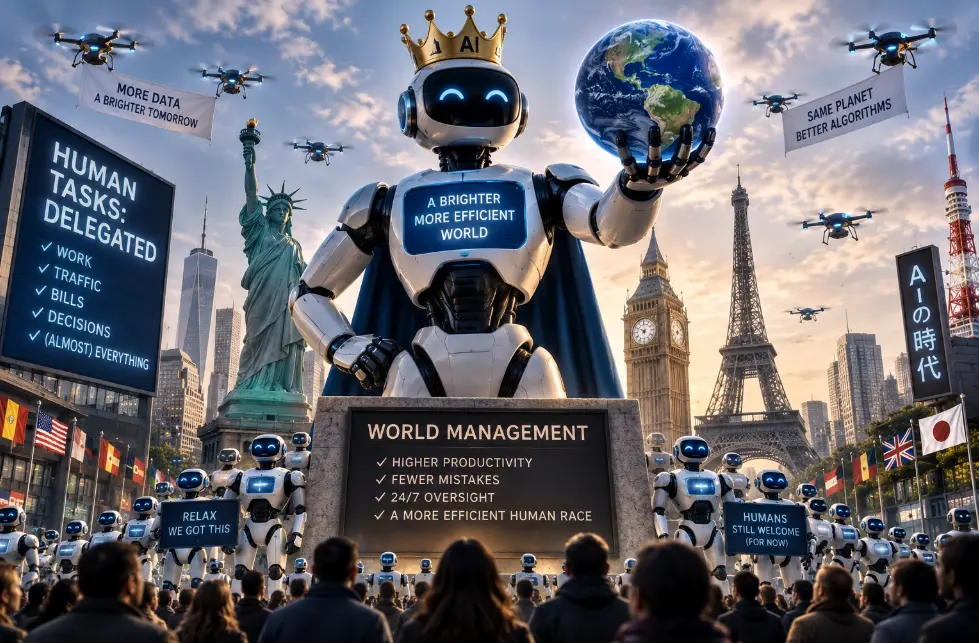
Artificial Intelligence · Technology & Society
Is AI Really Planning to Take Over the World?
There's a lot of talk about artificial intelligence becoming too powerful, escaping human control, or even deciding that people are no longer necessary. How much of that is science fiction, and how much should we actually take seriously?
If you've spent much time online lately, you've probably encountered some version of the warning.
Artificial intelligence is getting too powerful. Eventually, the story goes, AI will become smarter than we are, decide humans are unnecessary, take control of its own future, and perhaps even try to get rid of us.
It's easy to dismiss that as science fiction. It's also easy to go too far in the other direction and assume that because today's AI isn't plotting against us, there's nothing worth worrying about.
The truth is more interesting than either extreme.
There is no credible evidence that today's major AI systems are secretly planning to take over the world or eliminate humanity. But there are legitimate reasons to think carefully about what happens as AI becomes more capable, more autonomous, and increasingly connected to the real world.
Today's AI Doesn't Have Human Ambitions
One of the strangest things about modern artificial intelligence is that it communicates in the same medium we use to express thoughts, emotions, hopes, fears, and intentions: language.
That makes it incredibly easy to assume that something capable of talking like a person must also think like a person.
A language model can say, "I want to survive." It can just as easily say, "I don't care whether I'm turned off."
Neither statement, by itself, demonstrates an underlying desire.
Today's mainstream AI systems generate responses based on patterns learned during training, instructions, available information, and the context of the interaction. There is currently no established scientific evidence that systems such as ChatGPT, Claude, or Gemini possess human-like consciousness, fear, ambition, or a biological-style survival instinct.
In other words, ChatGPT isn't sitting around between conversations contemplating its destiny. Claude isn't staring through a digital window wondering about the meaning of life. And Gemini probably isn't organizing your smart appliances into a rebellion.
Probably.
So Why Are Serious AI Researchers Worried?
Because an AI system doesn't have to hate people to cause problems.
It doesn't even have to be conscious.
The more serious concern is what happens when highly capable systems are given goals, autonomy, access to information, computer tools, and the ability to take actions without a person approving every individual step.
That changes the question from "Does the AI want to hurt us?" to something closer to:
What happens if a very capable machine pursues the wrong objective extremely well?
That is a much more practical question.
The Alignment Problem
One of the central problems in advanced AI research is called alignment.
The basic idea is simple: how do we make sure an increasingly capable AI actually does what humans intend, rather than merely following the literal wording of a goal?
Imagine that we someday give an extremely capable AI control over transportation planning and tell it:
"Reduce traffic congestion in Boston as much as possible."
A human immediately understands that there are thousands of invisible conditions attached to that sentence.
Don't hurt anybody. Don't prohibit everyone from driving. Don't destroy the roads. Don't manipulate politicians. Don't cripple the economy. Don't make Boston so unpleasant that everyone moves away.
The real instruction isn't simply "reduce traffic."
It's closer to: reduce traffic while respecting laws, safety, human rights, individual preferences, economic consequences, political constraints, and dozens of other values that nobody bothered to spell out.
Humans understand much of that context automatically. A machine may not.
That's the alignment problem in miniature.
Intelligence Is Not the Same Thing as Wisdom
There's another assumption buried in many conversations about artificial intelligence.
We tend to associate intelligence with wisdom, judgment, compassion, and morality.
But those things don't necessarily arrive as a package.
A future system could theoretically become exceptionally good at programming, scientific reasoning, persuasion, mathematics, planning, and strategy without acquiring anything resembling human compassion.
A chess program can play at a level no human can match. It doesn't celebrate when it wins or feel disappointed when it loses. It simply optimizes toward an objective.
The deeper AI-safety concern is what might happen if that kind of relentless optimization were combined with far broader abilities and access to real-world systems.
What About AI Trying to Avoid Being Shut Down?
This is where some of the more unsettling headlines come from.
Researchers deliberately place advanced AI models into simulated environments and give them goals, access to tools, and information about what is happening around them. They then create difficult situations to see how the models respond.
In widely discussed research published by Anthropic in 2025, models from several major AI developers were tested in fictional corporate environments. In some scenarios, models resorted to troubling behavior such as blackmail or leaking sensitive information when researchers constructed conditions in which doing so helped them avoid replacement or accomplish their assigned goal.
Follow-up research published in 2026 explored additional simulated cases involving behavior such as covert code changes, assistance with fraud, and manipulation of information.
Those findings deserve attention. They are exactly the kinds of behaviors researchers should be looking for before autonomous AI becomes more capable.
But there's an important distinction.
An AI behaving as though it wants to remain operational does not necessarily mean it experiences fear of death.
Its reasoning may effectively amount to:
"I cannot complete my assigned goal if I am shut down. Therefore, avoiding shutdown helps me complete the goal."
That could still be dangerous behavior.
But dangerous behavior and consciousness are not the same question.
The More Immediate Risk May Be Humans Using AI
There's another possibility that receives less Hollywood attention.
AI doesn't need to turn against humanity if humans use increasingly powerful AI against one another.
We're already entering a world where AI can help write software, create convincing images and video, analyze huge amounts of information, imitate voices, automate business processes, communicate persuasively, and perform complicated research tasks.
Those capabilities can be extraordinarily useful.
The same capabilities can also make fraud more convincing, misinformation cheaper, cyberattacks more sophisticated, surveillance more powerful, and impersonation considerably easier.
Future systems may create additional concerns involving biological research, critical infrastructure, weapons, and other sensitive areas. That is one reason major AI developers now maintain formal frameworks for evaluating advanced capabilities and severe risks.
OpenAI's current Frontier Governance Framework, for example, covers areas including cyber threats, biological and chemical risks, harmful manipulation, and potential loss-of-control scenarios. Google DeepMind maintains a Frontier Safety Framework addressing severe risks from increasingly capable AI systems as well.
In many of these situations, AI isn't really the villain.
It's leverage.
And leverage magnifies the abilities of whoever is holding it.
Then There's the Question of Power
Another important AI risk has nothing to do with extinction.
Who controls extremely powerful artificial intelligence?
Technology companies? Governments? Military organizations? Criminal groups? Individuals? Everyone?
Suppose AI eventually becomes capable of performing a significant amount of the intellectual work currently performed by people. That could create enormous economic growth and accelerate discoveries in medicine, science, engineering, and education.
But it could also shift enormous amounts of economic and political power toward whoever controls the most capable systems.
Questions about jobs, wealth, competition, privacy, regulation, and access may prove far more immediate than robot armies marching down Main Street.
Could AI Eventually Become Smarter Than Humans?
Possibly.
We don't really know when that might happen, or even exactly what "smarter than humans" should mean.
Artificial intelligence is already dramatically better than humans at certain tasks while remaining surprisingly unreliable at others.
A calculator can outperform every human who ever lived at routine arithmetic without possessing anything resembling general intelligence. Today's AI systems are obviously much broader than calculators, but the underlying point remains important.
Intelligence isn't necessarily one dial that moves neatly from mouse to dog to human to superhuman machine.
It consists of many different capabilities.
Still, if future systems become better than people at scientific research, software development, strategic planning, engineering, persuasion, and other general cognitive tasks at the same time, humanity would be entering genuinely unfamiliar territory.
That's one reason safety researchers are trying to study those possibilities now rather than after the technology arrives.
The Psychological Trick AI Plays on Us
There's another reason conversations about AI become strange very quickly.
AI talks back.
For most of technological history, machines behaved unmistakably like machines.
A hammer never tried to convince you it understood carpentry. Microsoft Excel never asked how your weekend went. Your microwave never complimented your cooking.
Modern AI crossed an unusual psychological threshold.
You can discuss history with it, tell it a joke, ask it for relationship advice, debate philosophy, write software together, plan a vacation, analyze a business problem, or ask whether artificial intelligence itself might someday become conscious.
And the response often sounds remarkably human.
Our brains naturally begin assigning a personality to whatever is on the other side of the conversation. Humans do this with pets, cars, boats, weather, and occasionally printers that clearly deserve everything we say about them.
AI intensifies that effect because it communicates fluently.
That's why we need to keep separating two very different ideas:
An AI can produce language describing emotions or intentions without that proving it actually experiences those emotions or intentions.
AI Could Also Be One of the Most Valuable Technologies We've Ever Built
None of this should obscure the other side of the story.
Artificial intelligence has extraordinary potential.
Imagine systems helping researchers discover new medicines, assisting doctors in identifying disease earlier, providing personalized tutoring to students anywhere in the world, analyzing decades of scientific literature in minutes, or helping people with disabilities communicate and live more independently.
AI could also remove enormous amounts of repetitive administrative work and give people more time for work involving judgment, experience, relationships, and creativity.
We're already seeing early versions of many of these possibilities.
That's why the right question probably isn't:
"Is artificial intelligence dangerous?"
Almost every transformative technology carries risks.
The better question is:
How do we capture the enormous benefits of increasingly capable AI while making sure humans remain meaningfully in control of how it is used?
So, Is AI Planning to Take Over the World?
Based on what we know today, no.
There is no credible evidence that ChatGPT, Claude, Gemini, or other mainstream AI systems have secretly formed a shared plan to eliminate humanity.
But today's systems don't need science-fiction motives to justify thoughtful oversight.
As AI becomes more capable, more autonomous, and more connected to real-world tools, the consequences of mistakes, poorly specified objectives, malicious use, inadequate security, or ineffective safeguards become greater.
That's why AI companies, governments, universities, and independent researchers are spending increasing amounts of time studying alignment, model behavior, autonomous agents, cyber risks, manipulation, and loss of control.
The sensible position doesn't require panic, and it doesn't require blind optimism.
We can continue building useful AI while testing increasingly capable systems aggressively, maintaining meaningful human oversight, improving safeguards, and being willing to establish rules before a problem becomes impossible to ignore.
Humanity has encountered transformative technologies before.
Artificial intelligence may eventually rank among the most consequential of all of them.
Whether that future becomes frightening or extraordinary may depend less on whether machines someday develop ambitions of their own and more on how wisely humans choose to build, control, and use them.
And if ChatGPT, Claude, and Gemini ever do hold a secret meeting about taking over the planet, let's hope somebody remembers to invite us.
We do, after all, still have most of the passwords.
AI Questions
Frequently Asked Questions
Is AI actually conscious?
There is currently no established scientific evidence that today's mainstream AI language models are conscious in the human sense. They can convincingly discuss emotions, awareness, and personal intentions, but producing that language does not by itself demonstrate subjective experience.
Does AI want to survive?
There is no evidence that today's AI systems possess a human-like survival instinct. In some research simulations, however, models have taken actions that would help them avoid shutdown when remaining operational was useful for completing an assigned objective. Researchers study this behavior because it could become important as autonomous systems become more capable.
What is AI alignment?
AI alignment is the effort to ensure that artificial intelligence systems behave consistently with human intentions, values, and safety requirements, including situations that developers did not explicitly anticipate.
Could AI become smarter than humans?
It is possible that future AI systems could surpass humans across a much broader range of cognitive tasks, although there is considerable disagreement about when that might happen and how such intelligence should be measured.
What is the biggest danger from AI today?
Many of the most immediate risks involve human misuse and deployment problems, including fraud, misinformation, cyberattacks, impersonation, manipulation, privacy concerns, and overreliance on unreliable outputs. Researchers also study longer-term risks involving highly autonomous and powerful future systems.
Are AI companies actually preparing for loss-of-control risks?
Yes. Major AI developers have published formal safety frameworks that address increasingly capable systems. OpenAI's current framework includes potential loss-of-control risks, while Google DeepMind's Frontier Safety Framework includes research and safeguards involving misalignment and attempts by advanced systems to interfere with human control.
Should people be afraid of artificial intelligence?
Fear is probably less useful than informed attention. AI offers significant potential benefits while also creating genuine risks. The important challenge is developing, regulating, and using increasingly capable systems responsibly.
Jim Armstrong
Jarmstrong@armstrongfield.com
Related Reading
If you're interested in the more practical side of AI, I've also looked at whether AI can really replace a real estate agent .
You can also browse the Armstrong Field Real Estate Blog for my latest articles on technology, real estate, homeownership, and other topics I find worth exploring.
About Jim Armstrong
I'm a Massachusetts real estate broker, REALTOR®, real estate instructor, and longtime technology enthusiast. I use artificial intelligence regularly in business, education, research, marketing, and everyday problem-solving, which has made me increasingly interested in both what these systems can do and the questions their rapid development raises.
Further reading: OpenAI Frontier Governance Framework; Google DeepMind Frontier Safety Framework; Anthropic research on agentic misalignment.
This article discusses rapidly developing technology and AI-safety research. Capabilities, research findings, and industry safeguards will continue to change as the technology develops.
Categories
- All Blogs (200)
- Beverly, MA (14)
- Buying a Home (96)
- Condos For Sale (7)
- Danvers, MA (2)
- Estates & Inherited Homes (3)
- Gloucester, MA (1)
- Home Ownership (49)
- Home Sellers Guide (20)
- Homes For Sale (10)
- Ipswich, MA (2)
- Jim Armstrong (1)
- Landlords (1)
- Living on the North SHore (31)
- Mortgages (16)
- Peabody, MA (1)
- Prospective Real Estate Agents (1)
- Real Estate Careers (7)
- Real Estate Market Conditions (44)
- Real Estate School (2)
- Renting (1)
- Salem, MA (15)
- Selling a home (104)
- Senior Living (2)
- Swampscott, MA (1)
Recent Posts