
How to Price a North Shore MA Home in a Shifting Market

Pricing Your North Shore Home: Why You Should Price to Tomorrow's Market, Not Yesterday's Comps
A practical guide for sellers navigating a Massachusetts market that's still strong — but changing
If you've talked to a neighbor who sold their house on the North Shore a year ago, you probably heard some version of the same story: multiple offers, no contingencies, sold in a weekend. It's tempting to assume that's still exactly how it works. In a lot of ways, it still is — but not in every way, and not in every price point or property type. The market hasn't flipped upside down. It's shifted, and sellers who price based on last year's stories, or even last quarter's closed sales, are the ones most likely to sit on the market longer than they expected.
Here's the core idea I want to walk you through: a home doesn't sell at the price the market was six weeks ago. It sells at the price the market is on the day a buyer makes an offer — which is often 30, 60, even 90 days after you set that number. Pricing well means pricing for where the market is heading, not just where it's been.
The Comps You're Looking At Are Already History
A comparative market analysis — the report your agent puts together to help set a list price — is built almost entirely on closed sales. That's the only hard, verifiable data available. The problem is that a closed sale represents a price that was agreed on 30 to 60 days before it closed, for a home that likely went under contract even earlier than that. By the time you're looking at a comp, you're often looking at a decision three or four months old.
In a market that isn't moving much, that lag doesn't matter. But right now, with mortgage rates sitting in the high-6% range and inventory on the North Shore gradually building back up after several very tight years, conditions can shift meaningfully over a single season. A comp from the spring doesn't necessarily tell you what a buyer is willing to pay in late summer or fall.
What "Pricing to Tomorrow's Market" Actually Looks Like
This isn't about guessing or padding a number based on a hunch. It's about pricing with a fuller picture than closed sales alone provide. In practice, that means weighing a few additional signals alongside the standard comps:
Active and pending listings, not just sold ones
What's currently on the market in your town and price range, and how is it priced relative to what recently sold? If active listings are priced below recent closed comps, that's often an early signal that the market is softening at that price point — sellers and their agents are already adjusting. Pending sales (homes under contract but not yet closed) are an even more current data point, since they reflect decisions buyers made just days or weeks ago.
Absorption rate
This measures how quickly current inventory would sell at the current pace of sales. A shrinking absorption rate points to a market tilting further toward sellers; a rising one suggests buyers are gaining leverage. It's a more forward-looking number than a simple days-on-market average.
Price trend direction, not just price level
Two towns can have an identical median sale price and be headed in opposite directions. What matters for your pricing decision is the trend line, not the snapshot.
Property type and price band
Conditions on the North Shore aren't uniform across the board. Well-located, move-in-ready single-family homes are still seeing real competition in many towns. Condos, in a number of areas, including Salem, Beverly & Lynn, have softened somewhat as inventory has grown. A pricing strategy that works for one doesn't automatically work for the other.
Why This Matters More for Historic and Character Homes
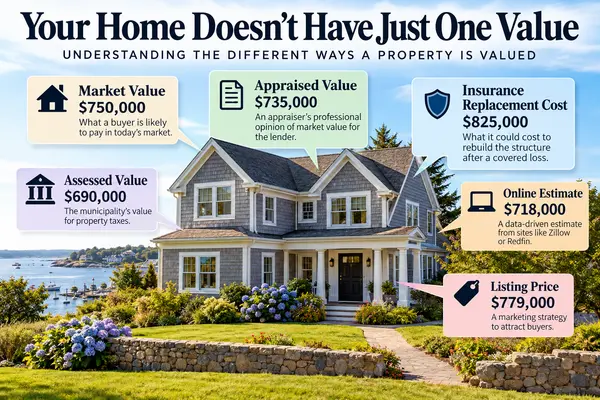
North Shore comps get complicated fast once you're outside cookie-cutter subdivisions. A c.1880 Salem colonial with original moldings and an updated kitchen doesn't compare cleanly to a similarly sized home two streets over with a different level of updating, a different lot, or a different amount of deferred maintenance. Automated valuation tools — the kind that generate an instant online estimate — are especially unreliable here, because they can't account for craftsmanship, condition, or the kind of character that either adds real value or signals a bigger project ahead. Pricing character-rich or historic North Shore homes accurately takes a hands-on comparison, not an algorithm.
The Real Cost of Pricing Too High "Just to See"
I understand the instinct. If the market has been strong, why not list a little high and see what happens? The honest answer is that this strategy tends to backfire, and it backfires in a specific, predictable way.
The first two to three weeks of a listing are when it gets the most attention — from agents setting up showings, from buyers who've been watching the market closely, and from the portals themselves, which tend to surface newer listings more prominently. If the price is set too high for what the market will currently bear, that early window passes with light showing activity and no offers. Then comes the price reduction, which is visible to every buyer and agent tracking the listing history. A home that's had a price cut, even a modest one, often reads to buyers as a home with a problem, even when the only problem was the original number.
The Pattern Worth Avoiding
Overpriced at list → weak first three weeks → price reduction → buyers assume something's wrong → longer time on market → final sale price often lands lower than if the home had been priced accurately from day one. This is one of the most common and most avoidable ways sellers leave money on the table.
Pricing accurately from the start — even if it feels a little conservative compared to what a neighbor's house sold for last year — tends to produce a faster sale, more competitive interest, and often a stronger final number than starting high and chasing the market down.
What This Means If You're Thinking About Listing in 2026/2027
None of this is a reason to be pessimistic about selling on the North Shore. Well-prepared, well-located homes are still performing well. It's a reason to be precise. The sellers who do best right now are the ones working with an agent who's tracking real-time activity — active listings, pending sales, and buyer feedback from actual showings — not just pulling a report of last quarter's closed sales and calling it a pricing strategy.
If you're weighing whether now is the right time to list, or you want a clear read on what your specific home would likely bring in today's market and where that number is trending, that's exactly the conversation worth having before you put a sign in the yard.
Frequently Asked Questions
What does "pricing to tomorrow's market" actually mean?
It means setting your list price based on where market conditions are heading, not just where they were when the most recent comparable sales closed. Since a home typically takes several weeks to go under contract and additional weeks to close, an accurate price accounts for the gap between today and that eventual closing date, using current active listings, pending sales, and absorption trends rather than closed sales alone.
Why can two homes with similar comps sell for different prices right now?
Condition, updates, lot, location within the neighborhood, and timing all matter — but so does how each home was priced relative to current buyer expectations. A home priced to reflect where the market is today, with realistic positioning against active competition, often outperforms a similar home priced purely off last season's sales.
Is the North Shore still a seller's market in 2026?
Conditions vary by town, price point, and property type, and they can shift over the course of a year. Single-family homes in many North Shore communities have continued to see solid demand, while some segments of the condo market have seen inventory grow. Ask for a current read on your specific town and property type before drawing conclusions — market-wide averages can be misleading at the neighborhood level.
How often should sellers reassess price once a home is listed?
The first two to three weeks are the most telling. If showing activity and buyer feedback don't match expectations in that window, it's worth a serious conversation about pricing rather than waiting it out. Beyond that, checking in against new comps and new competing listings every few weeks helps catch shifts early, before a listing goes stale.
Do rising mortgage rates affect how I should price my home?
Yes. Mortgage rates directly affect buyer purchasing power — a higher rate means a buyer qualifies for a smaller loan amount at the same monthly payment. When rates move, especially quickly, it can shift what buyers in your price range are able and willing to offer, which is part of why current active and pending data matters more than older closed comps.
What's the risk of pricing high "just to test the market"?
The main risk is losing the strongest selling window — the first few weeks a listing is live — followed by a price reduction that can make buyers wonder what's wrong with the home, even when the price was simply set too high. Homes that go through this cycle often end up selling for less, and after more time on market, than if they'd been priced accurately from the start.

Wondering What Your Home Would Bring in Today's Market?
I'll walk you through current activity in your neighborhood — not just last quarter's closed sales — so you can make a confident, well-timed decision.
Get Your Free Home ValuationCategories
- All Blogs (193)
- Beverly, MA (13)
- Buying a Home (92)
- Condos For Sale (6)
- Danvers, MA (2)
- Estates & Inherited Homes (3)
- Gloucester, MA (1)
- Home Ownership (49)
- Home Sellers Guide (18)
- Homes For Sale (10)
- Ipswich, MA (2)
- Jim Armstrong (1)
- Landlords (1)
- Living on the North SHore (30)
- Mortgages (15)
- Peabody, MA (1)
- Prospective Real Estate Agents (1)
- Real Estate Careers (7)
- Real Estate Market Conditions (43)
- Real Estate School (2)
- Renting (1)
- Salem, MA (14)
- Selling a home (100)
- Senior Living (2)
- Swampscott, MA (1)
Recent Posts