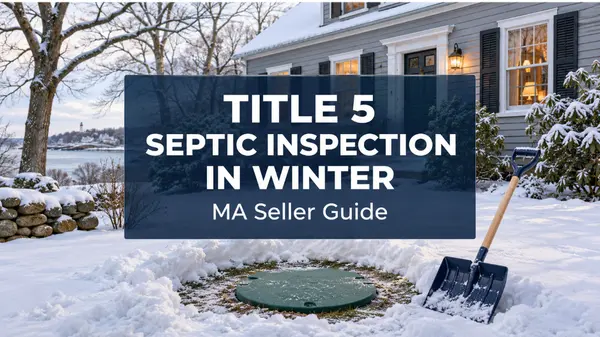

Title 5 Septic Inspections: A North Shore Guide for Sellers and Buyers
Title 5 Septic Inspections: A North Shore Guide for Sellers and Buyers
If you own a home in Boxford, Topsfield, Hamilton, Wenham, Essex, or parts of Ipswich, Gloucester, and other North Shore towns, there's a good chance your house isn't connected to a town sewer. That puts one Massachusetts regulation squarely in the middle of your sale or purchase: Title 5 of the State Environmental Code (310 CMR 15.000).
I teach this material to Massachusetts real estate licensees. Here is a plain-English guide to how Title 5 inspections work, what changes in winter, and your options if a system fails.
When Is a Title 5 Inspection Required?
The most common trigger is a sale. Under 310 CMR 15.301, a system must be inspected at or within two years before the transfer of title. MassDEP also requires inspections in other situations, including:
- Applying for a building or occupancy permit that changes the use or footprint of the property
- Dividing or combining properties
- Shared systems and large systems, on a periodic schedule
- When ordered by MassDEP or the local Board of Health
How long is an inspection valid?
A passing inspection for a sale is generally good for two years. If the report comes with pumping records showing the system was pumped at least once a year, it can be used for up to three years. Keep your pumping receipts.
Who does the inspection?
Only a MassDEP-approved System Inspector can perform a Title 5 inspection. An inspection by anyone else doesn't count toward compliance. The inspector files the results on the official MassDEP form with the local Board of Health within 30 days of the inspection, and the buyer must receive a complete copy of the report.
Pass, Conditional Pass, or Fail
Inspection results generally land in one of three places:
- Pass: The system meets Title 5 standards for the transfer.
- Conditional pass: A specific component needs repair, such as a cracked or metal septic tank, a broken or obstructed pipe, an uneven distribution box, or a malfunctioning pump chamber. These repairs are made with Board of Health approval.
- Fail: The system doesn't protect public health and the environment. Soil absorption systems (leach fields) and cesspools can't be fixed under a conditional pass.
A failed system generally must be upgraded within two years, unless the Board of Health or MassDEP sets a different schedule. That obligation stays with the owner even if the sale falls through.
Selling a Home With a Septic System This Winter
This is the question I hear most from November through March. Title 5 anticipates it. If weather conditions prevent an inspection before closing, the inspection can be completed as soon as weather permits, but no later than six months after the transfer, provided the seller notifies the buyer in writing.
That flexibility helps, but it shifts uncertainty onto the buyer, and some buyers and lenders won't be comfortable with it. My advice to sellers listing this winter or early spring:
- Inspect before you list if the ground allows it. It removes a major unknown.
- Gather your records now: pumping receipts, the system's as-built plan from the Board of Health, and any past inspection reports.
- Know where the tank and distribution box are. Finding covers under snow adds time and cost.
- Check local rules. Some towns add requirements on top of Title 5, so a quick call to the Board of Health is worth it.
If you're weighing whether to list now or wait, start with a free home value consultation for your North Shore home so the septic question is part of the plan from day one.
What Buyers Should Know
If you're buying a home with a private system, read the full inspection report, not just the result line. Ask how old the system is, when it was last pumped, and whether it has a leach field, a pump, or an alternative treatment component that needs ongoing maintenance. A passing report is not a warranty.
If the inspection hasn't been completed because of weather, talk with your attorney and lender about how the purchase and sale agreement will handle the results, such as an escrow if the system later fails. You can also search North Shore homes for sale .
Some transfers are exempt, such as refinancing and certain family transfers (see the FAQ below). Condominiums follow their own schedule: the association is responsible, and condos with five or more units are inspected every three years.
Financial Help if a System Fails
A failed system can be a significant expense, and there is help available:
- Massachusetts septic tax credit: According to the 2025 Schedule SC from the Department of Revenue, owners who repair or replace a failed system at their principal residence may claim 60% of eligible costs (on up to $30,000 of expenses), capped at $4,000 per year and $18,000 in total, with unused credit carried forward up to five years.
- MassHousing Septic Repair Loan Program: Low- and no-interest loans up to $25,000 for eligible owner-occupants of one- to four-family homes and condominiums, subject to income limits.
- Community Septic Management Program: Many towns offer low-interest betterment loans through their Boards of Health using state funds.
Talk with a tax professional before counting on the credit, since eligibility depends on your situation. For more guidance on preparing to sell, see our North Shore seller resources .
Frequently Asked Questions
How long is a Title 5 inspection good for in Massachusetts?
A Title 5 inspection done for a sale is generally valid for two years. It can be valid for up to three years if the report is accompanied by pumping records showing the system was pumped at least once a year.
Who pays for the Title 5 inspection, the buyer or the seller?
Title 5 makes the property owner responsible for arranging the inspection, so the seller typically orders and pays for it. A buyer and seller can agree in writing before closing to shift that responsibility, as long as the required timeframes are still met.
Can I sell my house in winter if the septic system can't be inspected?
Yes. If weather conditions prevent the inspection, it can be completed as soon as weather permits, but no later than six months after the transfer, provided the seller notifies the buyer in writing.
What happens if a septic system fails Title 5?
A failed system generally must be upgraded within two years, unless the local Board of Health or MassDEP authorizes a different schedule. The owner still has to repair the system even if the sale does not go through. In a sale, who pays for the upgrade is negotiable between buyer and seller.
Is there financial help for a failed septic system in Massachusetts?
Yes. Owners who repair or replace a failed system at their principal residence may qualify for a state income tax credit of 60% of eligible costs, up to $4,000 per year and $18,000 in total. MassHousing's Septic Repair Loan Program offers low- and no-interest loans up to $25,000 for eligible owner-occupants, and many towns offer betterment loans through the state's Community Septic Management Program.
Are any property transfers exempt from a Title 5 inspection?
Yes. Examples include refinancing, transfers between spouses, and transfers of residential property between parents and children or full siblings, among others listed in 310 CMR 15.301. Ask your real estate attorney to confirm whether a specific transfer qualifies.
Categories
- All Blogs (213)
- Beverly, MA (14)
- Buying a Home (103)
- Condos For Sale (8)
- Danvers, MA (2)
- Estates & Inherited Homes (4)
- Gloucester, MA (1)
- Home Ownership (50)
- Home Sellers Guide (20)
- Homes For Sale (10)
- Ipswich, MA (2)
- Jim Armstrong (1)
- Landlords (1)
- Living on the North SHore (31)
- Mortgages (17)
- Peabody, MA (2)
- Prospective Real Estate Agents (1)
- Real Estate Careers (7)
- Real Estate Market Conditions (46)
- Real Estate School (2)
- Renting (1)
- Salem, MA (16)
- Selling a home (114)
- Senior Living (2)
- Swampscott, MA (1)
Recent Posts