
What the 21st Century Housing Act Means for North Shore Buyers & Sellers
Congress Just Passed the Biggest Housing Bill in Two Decades. Here's What It Means for You.
A plain-English breakdown of the 21st Century ROAD to Housing Act — and what it could mean for buyers, sellers, and homeowners on Massachusetts' North Shore.
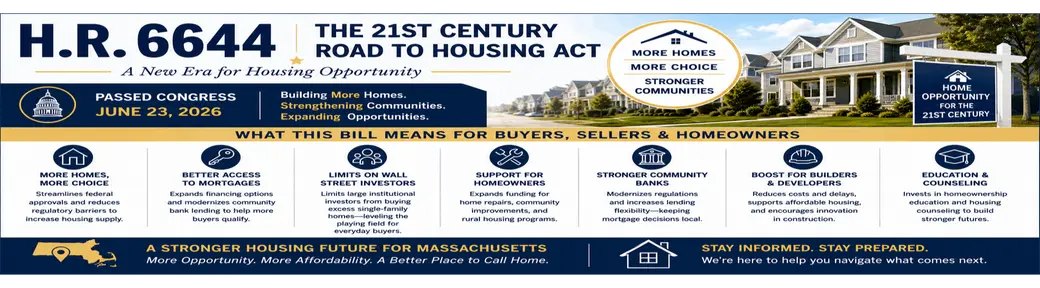
Something significant just happened in Washington — and for once, it's not partisan bickering. On June 22–23, 2026, both the Senate and the House voted by overwhelming margins to pass the 21st Century ROAD to Housing Act (H.R. 6644), described by legislators from both parties as the most significant federal housing legislation in nearly twenty years.
The margins tell the story: 85–5 in the Senate, 358–32 in the House. That kind of bipartisan agreement doesn't happen by accident. It reflects how broadly the housing affordability problem is felt — from California to Massachusetts and everywhere in between.
So what does it actually do? And more importantly, what does it mean for you if you're buying, selling, or owning a home on Massachusetts' North Shore? Let me walk you through it.
* Vote counts from Congress.gov and GovTrack. Thresholds per final enrolled bill text as of June 22, 2026.
First, a Quick Note on Timing
The bill is not yet law as I write this — it's on its way to President Trump's desk. He's expected to sign it. But even after that happens, most of these provisions don't flip on like a light switch. Federal rulemaking takes time. What this legislation does is set the direction — and for anyone making decisions about buying or selling a home in the next year or two, the direction matters.
The Big Headline: Restricting Large Institutional Investors
This is the provision that got the most attention, and honestly, the most political energy. Under the final bill, any entity that directly or indirectly controls 350 or more single-family homes is prohibited from purchasing additional single-family properties.
The thinking behind it is straightforward. When large investment funds compete with individual families for the same homes, families tend to lose. The legislation is built around a simple premise — in President Trump's words from his State of the Union — "homes are for people, not corporations."
A few important details worth understanding:
Investors who already own homes before the law takes effect are not required to sell them. This is not a retroactive measure.
Build-to-rent programs and homes requiring significant renovation are carved out — the goal is to prevent competition for existing homes, not halt all investor activity in housing. Renters in investor-owned homes get a right of first refusal and a 30-day "first look" period if their home is sold.
The restriction is set to expire 15 years after it takes effect. Congress is treating this as a course correction, not a permanent restructuring of property rights.
What This Means on the North Shore
To be direct: large institutional investors were never a dominant force in the Beverly, Salem, and Danvers markets. This region's housing stock — historic homes, smaller multi-families, coastal properties — wasn't the primary target of the investment funds this law aims at. The practical impact here will likely be modest at first.
What it could do over time is reduce competition in nearby markets, which in turn keeps buyers focused on North Shore inventory rather than being pushed out of other corridors. That's not nothing.
Increasing the Supply of Housing
The more consequential piece of this legislation — especially for the long term — is everything aimed at getting more homes built. The supply problem is what's really driving the affordability crisis, and this bill takes several angles at it.
Streamlining environmental and regulatory reviews
According to HUD Secretary Turner, regulations now account for roughly 25% of the cost of a single-family project and 40% of multifamily development. The bill directs agencies to streamline environmental reviews for residential construction and reduces the bureaucratic friction that adds months and dollars to every new home built.
Publishing land use guidelines and best practices
The federal government will develop and publish frameworks that states and cities can use to modernize their zoning. This includes guidance on transit-oriented development — meaning more housing near train stations — and on processes that speed up approvals for projects that include affordable units. For commuter rail towns like Beverly, Salem, and Danvers, this could matter over time.
Encouraging more types of housing
The bill specifically targets obstacles to manufactured housing, modular homes, and accessory dwelling units. It's an acknowledgment that the country can't build its way out of this problem using only traditional site-built single-family homes. More housing types, in more locations, at lower construction costs — that's the theory.
FHA multifamily loan limit increases
The legislation updates the statutory maximum loan limits for FHA-insured multifamily mortgages to better match current construction costs. This matters for apartment developers who rely on FHA financing — and for renters and buyers who benefit when more rental supply comes online.
"The goal is to make it easier to build and afford housing — modernizing outdated government programs, lowering costs by removing unnecessary federal requirements, and increasing local flexibility."
Expanding Financing Options for Buyers
Several provisions in the bill touch on how people finance home purchases, and some of these are directly relevant to buyers in our market.
FHA small-dollar mortgages
The bill directs attention to what's sometimes called the "small dollar mortgage problem." Getting a loan for a home priced under $150,000 or $200,000 can be disproportionately difficult because lenders earn less and the compliance burden is the same as on a larger loan. The bill addresses compensation structures for loan originators handling smaller loans, which should help in markets where starter homes — when they do exist — sit at the lower end of the price range.
Down payment and closing cost assistance
The reformed HOME Investment Partnerships program explicitly expands eligible uses to include down payment assistance, closing costs, and interest rate buydowns for buyers purchasing existing homes. This is meaningful for first-time buyers who have enough income to qualify but struggle to accumulate the cash needed upfront.
Manufactured housing reforms
The legislation eliminates the requirement that manufactured homes be built on a "permanent chassis" — a technical change that quietly opens up more locations and lowers construction costs for factory-built housing. Higher FHA loan limits for manufactured homes expand financing access for buyers considering this often-overlooked path to ownership.
Housing counseling reforms
The bill strengthens and reforms HUD's housing counseling program, with provisions to ensure counseling is available to buyers who become delinquent on federally backed mortgages. Better access to guidance at the right moment can prevent foreclosures. It's unsexy policy — but it matters.
What This Means If You're Selling
The honest answer: not much changes in the near term for North Shore sellers.
Demand for well-prepared homes in Beverly, Salem, Danvers, and the surrounding towns remains strong. The buyer pool driving that demand is primarily individual families and people relocating from more expensive markets — not investment funds. The institutional investor restriction largely doesn't affect the dynamics you're already navigating.
Where sellers might see indirect effects — years down the line — is if supply-side reforms actually produce more inventory. More homes on the market means more choices for buyers, which means pricing pressure on sellers. But that shift won't happen overnight. Federal policy moves slowly, and local zoning and construction timelines move even more slowly.
What sellers should focus on right now is what they can control: preparation, pricing strategy, and working with someone who understands this specific market. That hasn't changed.
What This Means If You're Buying
If you're a buyer — especially a first-time buyer — this legislation is more relevant to you, though again, mostly over the medium term.
Expanded FHA financing tools, stronger down payment assistance programs, and a more streamlined path to manufactured and modular housing all speak to buyers who are trying to break into a market that has not been easy. The removal of large investor competition is also an improvement, however modest in practical terms here.
The commuter rail towns of Essex County — Beverly, Salem, Ipswich, Hamilton — stand to benefit if transit-oriented development guidance encourages more housing density near the Newburyport/Rockport line. More units in these corridors would mean more options for buyers who want North Shore quality of life without an hour-plus commute.
A Note on What This Law Doesn't Do
It's worth being honest about the limitations. This bill does not lower mortgage rates. It does not create a massive new federal spending program. It does not mandate that any particular city change its zoning (the guidelines are not binding). Critics — some credible ones — have pointed out that restricting institutional investors who own fewer than 1% of all single-family homes nationally won't dramatically change affordability on its own.
What the law does is move a lot of levers in the same direction at the same time. Supply-side deregulation. Expanded financing tools. Reduced investor competition. Better housing counseling. Incentives for transit-oriented development. None of these alone is transformative. Together, over time, they could make a real difference.
Whether they will depends heavily on implementation — which means federal rulemaking, state and local responses, and private sector behavior. This is a beginning, not an ending.
Questions About How This Affects Your Situation?
Whether you're thinking about buying or selling on the North Shore, I'm happy to talk through what this legislation actually means for your specific circumstances — no obligation.
Schedule a Free ConsultationExplore First-Time Buyer Resources →
Frequently Asked Questions
What is the 21st Century ROAD to Housing Act?
It's the most significant federal housing legislation in nearly two decades, combining the House's Housing for the 21st Century Act (H.R. 6644) and the Senate's ROAD to Housing Act. It passed both chambers of Congress in June 2026 with overwhelming bipartisan margins and awaits the President's signature. Its goals include increasing housing supply, reducing regulatory barriers to construction, expanding financing options, and restricting large institutional investors from purchasing single-family homes.
How does the institutional investor restriction work?
Any entity that directly or indirectly controls 350 or more single-family homes is prohibited from purchasing additional single-family properties. It does not require existing investors to sell homes they already own. There are exceptions for build-to-rent programs and homes requiring significant renovation. The restriction is set to expire 15 years after the law takes effect.
Will this law help first-time homebuyers in Massachusetts?
Potentially, yes — in a few ways. The institutional investor restriction removes some competition for single-family homes. Reforms to FHA loan limits, manufactured housing finance, and down payment assistance programs through the HOME program expand access for buyers with smaller budgets or non-traditional paths to ownership. The longer-term goal is more homes being built, which should gradually ease supply constraints even in markets like Essex County.
Does this affect home sellers on the North Shore?
Not dramatically in the near term. North Shore sellers are primarily dealing with individual buyers, not investment funds. Demand in Beverly, Salem, and the surrounding towns remains driven by families and relocators, not institutional capital. Over a longer time horizon, if supply-side reforms add meaningful inventory to the market, that could shift pricing dynamics — but that's a slow-moving process.
What does the bill do about housing supply?
The law pushes the federal government to publish land use best practices, streamline environmental reviews for residential construction, and incentivize transit-oriented development. It also includes grant programs to support local home building, changes to manufactured housing rules that could lower construction costs, and FHA multifamily loan limit increases that make it easier to finance larger apartment projects.
Is the 21st Century ROAD to Housing Act signed into law yet?
As of late June 2026, the bill passed the Senate on June 22 and the House on June 23. It now goes to President Trump for signature. Most provisions require additional federal rulemaking before they take effect, so implementation will unfold over months and years. We'll update this post as things develop.

Categories
- All Blogs (202)
- Beverly, MA (14)
- Buying a Home (98)
- Condos For Sale (7)
- Danvers, MA (2)
- Estates & Inherited Homes (3)
- Gloucester, MA (1)
- Home Ownership (49)
- Home Sellers Guide (20)
- Homes For Sale (10)
- Ipswich, MA (2)
- Jim Armstrong (1)
- Landlords (1)
- Living on the North SHore (31)
- Mortgages (16)
- Peabody, MA (2)
- Prospective Real Estate Agents (1)
- Real Estate Careers (7)
- Real Estate Market Conditions (44)
- Real Estate School (2)
- Renting (1)
- Salem, MA (15)
- Selling a home (104)
- Senior Living (2)
- Swampscott, MA (1)
Recent Posts