
Mortgage Rates Are Rising Again—But Here’s What Buyers Need to Know Right Now
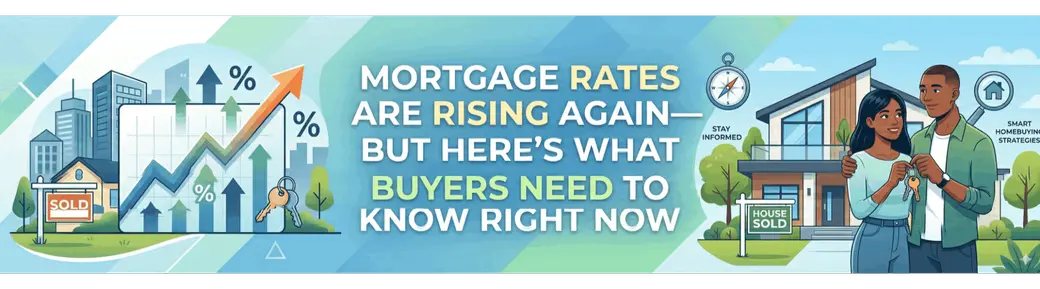
Mortgage Rates Are Rising Again—But Here’s What Buyers Need to Know Right Now
After dipping below 6% not long ago, mortgage rates have started creeping back up—and naturally, that’s getting buyers a little uneasy.
But here’s the bigger picture:
Even with the recent uptick, today’s rates are still lower than they were at this time last year, which means affordability—while not perfect—is actually improving compared to where we’ve been.
So what’s really going on?
What’s Happening With Mortgage Rates
According to Freddie Mac, the average 30-year fixed mortgage is now sitting around 6.46%—up from the brief dip we saw earlier this spring.
At the same time, buyer activity is showing signs of hesitation.
Data from the Mortgage Bankers Association shows:
-
Purchase applications are only up about 1% year-over-year
-
And actually down 3% week-over-week
Earlier in the year, we were seeing much stronger momentum. Now? Buyers are starting to pause and reassess.
Why Buyers Are Pumping the Brakes
This isn’t just about rates—it’s about confidence.
When rates move quickly (even if they’re still historically reasonable), it creates uncertainty:
-
“Should I wait?”
-
“Will rates drop again?”
-
“Am I buying at the wrong time?”
And that hesitation shows up almost immediately in buyer behavior.
Interestingly, government-backed loan programs like FHA and VA are holding up better right now—likely because those buyers tend to be more payment-focused and less rate-sensitive.
Let’s Put Rate Changes Into Perspective

Here’s where things get real—and where a lot of buyers misunderstand the impact.
A jump from about 6.0% to 6.46% sounds significant… but what does it actually mean?
On a $300,000 loan:
-
At ~5.98% → roughly $1,798/month
-
At ~6.46% → roughly $1,888/month
That’s about a $90/month difference
Not nothing—but also not the deal-breaker many people assume.
👉 In many cases, home price, taxes, and insurance fluctuations have a bigger impact than a small rate swing.
The Real Strategy Smart Buyers Are Using

Here’s what experienced buyers (and savvy agents) understand:
1. Shop Rates—Seriously
Not all lenders are created equal. Even a 0.25% difference can save thousands over time.
2. Focus on the Monthly Payment, Not the Headline Rate
The right question isn’t: “Is this the lowest rate possible?”
It’s: “Does this payment fit comfortably into my life?”
3. Have a Mortgage Pro in Your Corner
Markets like this reward buyers who stay informed in real time—not the ones guessing based on headlines.
4. Don’t Try to “Time” the Market Perfectly
Rates will move. They always do.
The buyers who win are the ones who:
- Buy when it makes sense for their life
-
Lock when the numbers work
-
Refinance later if/when rates improve
Bottom Line
Yes—rates have ticked up again.
But:
-
They’re still better than last year
-
The payment impact is often manageable
-
And opportunities are still out there for prepared buyers
If anything, markets like this tend to reward decisiveness and good guidance, not waiting on the sidelines.
Thinking About Buying?
If you’re trying to make sense of today’s market—and whether now is the right time for you—that’s a conversation worth having.
The numbers only tell part of the story. The strategy is where the advantage is.
Frequently Asked Questions About Mortgage Rates
How do rising mortgage rates affect homebuyers?
Rising mortgage rates increase the cost of borrowing, which can lead to higher monthly payments and slightly reduced purchasing power. However, the actual impact often depends on the price of the home, your down payment, taxes, and insurance—not just the rate alone.
Should I wait for mortgage rates to go down before buying?
Trying to time the market perfectly is difficult—even for professionals. Many buyers choose to move forward when the home and monthly payment make sense for their situation, with the option to refinance later if rates improve.
How much does a small increase in mortgage rates affect my monthly payment?
In many cases, less than you might think. For example, on a $300,000 loan, a rate increase of less than half a percent may only raise your monthly payment by around $75–$100. It’s important to look at the full financial picture, not just the rate.
Why is it important to shop around for a mortgage?
Not all lenders offer the same rates, fees, or loan programs. Getting multiple quotes can save you thousands of dollars over the life of your loan—and sometimes even lower your monthly payment right from the start.
What’s more important—the interest rate or the monthly payment?
The monthly payment is what impacts your day-to-day life. While the interest rate matters, a smart strategy focuses on securing a payment that fits comfortably within your budget and long-term financial goals.
Are there loan programs that perform better when rates rise?
Yes. Government-backed loans like FHA and VA often remain more stable during rate increases and can be more forgiving with credit or down payment requirements. These programs can be a strong option for many buyers, especially first-time purchasers.
SEARCH NORTH SHORE MA HOMES FOR SALE
Categories
- All Blogs (193)
- Beverly, MA (13)
- Buying a Home (92)
- Condos For Sale (6)
- Danvers, MA (2)
- Estates & Inherited Homes (3)
- Gloucester, MA (1)
- Home Ownership (49)
- Home Sellers Guide (18)
- Homes For Sale (10)
- Ipswich, MA (2)
- Jim Armstrong (1)
- Landlords (1)
- Living on the North SHore (30)
- Mortgages (15)
- Peabody, MA (1)
- Prospective Real Estate Agents (1)
- Real Estate Careers (7)
- Real Estate Market Conditions (43)
- Real Estate School (2)
- Renting (1)
- Salem, MA (14)
- Selling a home (100)
- Senior Living (2)
- Swampscott, MA (1)
Recent Posts