
How Much House Can I Afford? What North Shore MA Home Buyers Need to Know.
How Much House Can I Afford? What North Shore Buyers Need to Know Before They Start Looking
Understanding your real budget before you fall in love with a home — a practical guide for buyers in Beverly, Salem, Danvers, and the rest of the North Shore.

It's one of the first questions I hear from buyers, and it's exactly the right question to ask. Before you start browsing listings in Salem or scheduling showings in Beverly, you need to know what you can realistically spend — not just what a lender might technically approve you for.
Those two numbers are often very different, and the gap between them is where a lot of buyers get into trouble.
Here's how I walk buyers through the affordability question, and what you need to get clear on before you start seriously shopping for a home on the North Shore.
Start with Your Take-Home Pay, Not Your Salary
Most affordability calculators ask for your gross income — what you earn before taxes. That's a reasonable starting point, but it's not the number that actually matters when you're sitting down to pay your bills every month. What matters is what lands in your bank account after federal and state taxes, health insurance, and retirement contributions.
Massachusetts has a flat income tax rate of 5% (plus a 4% surtax on incomes above $1 million). That's on top of federal taxes. By the time you factor everything in, many buyers are working with 65–75% of their gross salary as actual spendable income.
Start there. Know your real monthly take-home number before you do anything else.
What the North Shore Market Actually Looks Like
It helps to be honest about what your budget will get you here. The North Shore is not an inexpensive market. Salem, Beverly, Danvers, and the surrounding towns have seen consistent appreciation over the past decade, and inventory remains limited for single-family homes.
As a rough orientation — and these numbers shift, so confirm with me before making any decisions — here's how purchase prices generally break down by budget range on the North Shore:
| Budget Range | What You're Likely to Find | Key Consideration |
|---|---|---|
| Under $500K | Condos in most towns; entry-level single-families in Peabody, Danvers outskirts | Competition is intense in this range; be ready to move quickly |
| $500K–$750K | Solid single-family options in Beverly, Salem, Danvers, Hamilton | Good inventory; move-in ready homes sell fast |
| $750K–$1.2M | Larger or updated homes, desirable neighborhoods, some waterviews | Strong market; strong homes get multiple offers |
| $1.2M+ | Luxury, waterfront, historic estates, Manchester/Gloucester/Marblehead | Longer days on market; more negotiating room |
Note: These ranges are general guidance based on current market conditions and will shift over time. Always verify current pricing with your agent before making any decisions.
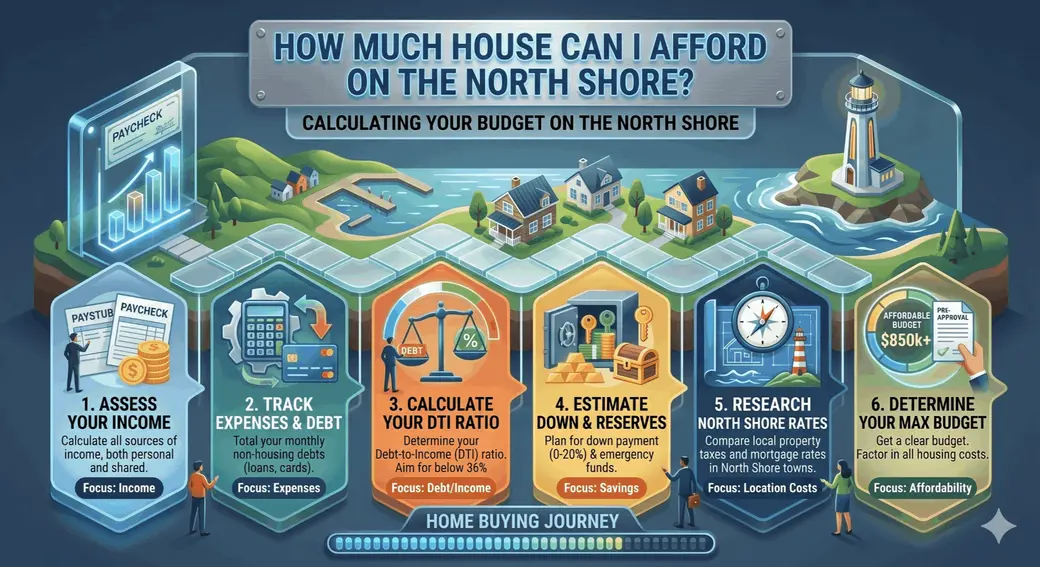
The Four Numbers That Actually Determine Your Budget
1. Your Credit Score
Your credit score is one of the most important factors in determining both whether you qualify for a mortgage and what interest rate you'll be offered. A difference of 40–60 points in your credit score can translate to a meaningfully higher or lower monthly payment — sometimes hundreds of dollars per month over the life of a loan.
Conventional loans generally require a minimum score around 620, but the best rates typically go to borrowers with scores of 740 or above. Before you do anything else, pull your credit report. You're entitled to free reports from all three major bureaus at AnnualCreditReport.com. Review them for errors — they're more common than people expect, and correcting one can move your score meaningfully.
2. Your Down Payment
The size of your down payment affects your loan amount, your monthly payment, and whether you'll need to pay for private mortgage insurance (PMI). PMI is typically required when you put down less than 20% on a conventional loan, and it adds to your monthly costs.
That said, 20% down is not a requirement to buy a home. There are several programs available to Massachusetts buyers — including MassHousing programs designed specifically to help buyers with down payments and closing costs — that allow qualified buyers to put down considerably less. First-time buyers in particular should look into these options before assuming they need to wait until they've saved a larger down payment.
3. Your Debt-to-Income Ratio (DTI)
Lenders look at two versions of your debt-to-income ratio. The "front-end" ratio is just your housing costs divided by gross income. The "back-end" ratio includes all monthly debt obligations — car payments, student loans, credit cards — plus your projected housing payment. Most conventional lenders want to see a back-end DTI below 43%, though some loan programs allow higher ratios.
If you're carrying significant debt, it's worth running the numbers before you go to a lender. You may find that paying down a car loan or credit card balance first puts you in a materially better position to buy.
4. Your Cash Reserves
Lenders want to see that after your down payment and closing costs, you still have some savings left. But beyond satisfying a lender, you genuinely want a cushion. Homeownership comes with unexpected expenses — a roof repair, a furnace, a failed water heater. Buying a home and being completely tapped out financially is stressful in a way that erases a lot of the satisfaction of owning.
A reasonable target is to have two to three months of housing expenses in accessible savings after closing. More is better.
Getting pre-approved isn't just a formality. In a competitive market like the North Shore, sellers and their agents take pre-approval seriously. It tells them you've done the work, you know your number, and you're ready to move. Walking into a negotiation without it puts you at a real disadvantage.
Pre-Qualification vs. Pre-Approval: Know the Difference
These terms get used interchangeably, but they mean very different things.
Pre-qualification is an informal estimate based on self-reported information. A lender asks you about your income, debts, and assets, and gives you a rough sense of what you might qualify for. It takes a few minutes and involves no verification. It also carries very little weight with sellers.
Pre-approval is a formal process. The lender pulls your credit, reviews documentation of your income and assets, and issues a written letter stating the loan amount you're approved for. It takes longer and requires some paperwork, but it's what you need when you're ready to make an offer in a competitive market.
In most North Shore transactions today, a pre-approval letter — not just a pre-qualification — is expected before an offer will be taken seriously.
What Pre-Approval Tells You (and What It Doesn't)
Your pre-approval letter will state a maximum loan amount. That number reflects what the lender is willing to lend you based on your financial profile. It is not a recommendation for what you should spend.
Plenty of buyers get approved for more than they're truly comfortable spending each month. Lenders care about your ability to repay the loan — they're less concerned with whether your monthly payment leaves you with enough room to enjoy your life.
That's your job. Think about what monthly payment feels genuinely comfortable — not just technically manageable, but actually comfortable — and work backward from there to find your real price ceiling. Then shop within that range.
First-Time Buyer Programs in Massachusetts
If you're buying your first home on the North Shore, it's worth knowing that you have options beyond a standard 30-year conventional mortgage. Massachusetts has programs specifically designed to make homeownership more accessible, and many buyers who could benefit from them never find out they qualify.
MassHousing, in particular, offers programs that can help with both your down payment and closing costs. Some of these programs are available at income levels that might surprise you — you don't have to be in a low-income bracket to qualify. I've worked with buyers who assumed these programs weren't for them and were genuinely surprised to learn otherwise.
You can read more about Massachusetts first-time buyer programs in our buyer guides, and I'm always happy to talk through what might apply to your specific situation.
When to Have This Conversation with an Agent
Ideally, before you've spent too much time looking at homes. One of the most common mistakes I see is buyers who spend months casually browsing listings, then sit down with a lender and discover their real budget is different — sometimes significantly different — from what they assumed.
Having an honest budget conversation early saves you from falling in love with homes you can't actually afford, and it lets you focus your search where it will actually lead somewhere productive.
If you're thinking about buying on the North Shore — whether that's six months from now or two years from now — a free consultation is a good place to start. We'll talk through your situation, help you understand what your budget realistically looks like in this market, and point you toward the right next steps. There's no pressure and no obligation. You can view current listings to get a sense of the market, and when you're ready, reach out to set up time to talk.
Frequently Asked Questions
How much house can I afford on the North Shore of Massachusetts?
A general starting point is keeping your total housing costs — mortgage, property taxes, and insurance — under 28% of your gross monthly income. But affordability on the North Shore depends on your credit score, down payment, existing debts, and the specific town you're buying in. Property tax rates vary significantly between Salem, Beverly, Danvers, and other communities, which affects your true monthly cost at any given purchase price. Getting a mortgage pre-approval is the most reliable way to understand your actual budget in this specific market.
What credit score do I need to buy a home in Massachusetts?
Most conventional loans require a minimum score of around 620, though you'll typically get better interest rates with a score of 740 or higher. FHA loans allow lower scores in some cases. MassHousing programs, which are designed for Massachusetts buyers, have their own credit requirements that vary by program. Before assuming you don't qualify, it's worth speaking with a lender directly — credit requirements and available programs change regularly.
Do I need 20% down to buy a home on the North Shore?
No. While a 20% down payment eliminates the need for private mortgage insurance (PMI) on conventional loans, many buyers purchase homes with 3%, 5%, or 10% down. Massachusetts first-time buyer programs through MassHousing can also provide down payment and closing cost assistance to qualified buyers. The right down payment amount depends on your financial situation, available cash, and what programs you may qualify for.
What is the difference between pre-qualification and pre-approval?
Pre-qualification is an informal estimate based on information you provide to a lender — it involves no verification and carries limited weight. Pre-approval is a formal process where the lender pulls your credit and verifies your income, assets, and debts, resulting in a written letter. In today's North Shore market, sellers expect to see a pre-approval letter when you submit an offer. Pre-qualification alone is unlikely to be taken seriously in a competitive situation.
What are the property taxes like in Beverly, Salem, and Danvers?
Property tax rates vary by municipality and are set annually. The rates in Salem, Beverly, and Danvers each differ, which means the same purchase price in different towns can result in meaningfully different monthly housing costs. When comparing homes across towns, always factor the local tax rate into your total budget calculation — not just the mortgage payment. Your agent or lender can help you understand the full monthly cost picture for any specific property.
When should I talk to a real estate agent about buying a home?
Earlier than most people think. Having a conversation with an agent before you've spent significant time browsing listings helps you understand your realistic budget, identify which towns and price ranges align with your goals, and avoid the common mistake of falling in love with homes outside your reach. A free buyer consultation carries no obligation — it's simply a chance to get organized and start the process with accurate information.
Ready to Figure Out Your Real Number?
A free consultation with Jim Armstrong is a good first step — no pressure, no obligation. We'll talk through your budget, what the North Shore market looks like at your price point, and what you'll need to get started.
Schedule a Free ConsultationArmstrong Field Group · Aluxety Real Estate · North Shore, MA
Categories
- All Blogs (195)
- Beverly, MA (13)
- Buying a Home (93)
- Condos For Sale (6)
- Danvers, MA (2)
- Estates & Inherited Homes (3)
- Gloucester, MA (1)
- Home Ownership (49)
- Home Sellers Guide (18)
- Homes For Sale (10)
- Ipswich, MA (2)
- Jim Armstrong (1)
- Landlords (1)
- Living on the North SHore (31)
- Mortgages (15)
- Peabody, MA (1)
- Prospective Real Estate Agents (1)
- Real Estate Careers (7)
- Real Estate Market Conditions (44)
- Real Estate School (2)
- Renting (1)
- Salem, MA (15)
- Selling a home (100)
- Senior Living (2)
- Swampscott, MA (1)
Recent Posts