

Best Home Upgrades Before Selling: Highest ROI, Biggest Wastes, and What to Do Instead
Best Home Upgrades Before Selling: Highest ROI, Biggest Wastes, and What to Do Instead
Not every dollar you put into your home comes back at closing — and some improvements actually cost you money. Here's how to spend smart before you list.
One of the most common conversations I have with sellers is about pre-listing improvements. It usually starts the same way: "Should we redo the kitchen before we list?" And the honest answer is almost always: it depends — and probably not the full renovation you're imagining.
After more than 25 years of selling homes on the North Shore, I've watched sellers spend $40,000 on a kitchen renovation and net maybe $15,000 of it back. I've also watched sellers spend $800 on fresh paint and a deep clean and get multiple offers over asking. The difference isn't the dollar amount — it's knowing what buyers in our market actually respond to.
This guide is my attempt to give you a clear-eyed look at where your money goes to work, where it disappears, and how to make the decisions that actually protect your bottom line.
What "Return on Investment" Actually Means for Sellers
When the real estate industry talks about ROI on home improvements, they're talking about how many cents on the dollar you recover at closing. A project with 80% ROI means if you spend $10,000, you're likely to get about $8,000 of that reflected in your sale price. Nothing is guaranteed — local market conditions matter enormously — but the national data gives us a reasonable starting point.
Here on the North Shore, a few additional factors shape the math: buyers are drawn to coastal character and historic detail, they're paying close attention to how well a home has been maintained, and they're acutely aware of the costs of Massachusetts winters. Those factors push some improvements higher on the priority list than they'd be in other markets.
ROI data from national real estate surveys is a useful guide, but no two homes or neighborhoods are identical. Before spending significant money on any pre-listing improvement, I'd recommend a walkthrough with me first. Sometimes the thing you think needs work isn't what buyers care about — and vice versa.
The High-ROI Improvements Worth Doing
These are the projects that consistently pay off — not necessarily in spectacular ways, but reliably. They either recover most of their cost in a higher sale price, reduce time on market, or both.
Fresh Paint — Inside and Out
Paint is the single highest-ROI improvement most sellers can make. It's inexpensive relative to almost any other project, it's immediately visible, and buyers interpret fresh paint as a signal that the home has been cared for. Interior painting of the main living areas — in warm, neutral tones — consistently returns more than it costs when you factor in the effect on buyer perception and offer price.
For the exterior, if your trim is peeling or your front door looks tired, paint before you list. First impressions form fast. A well-painted exterior says "this place has been looked after." A peeling one says "what else has been neglected?"
One of the few improvements that can return more than it costs. Neutral tones in main living areas are almost always worth doing.
Dramatically affects first impressions. High impact for coastal homes where salt air weathers paint faster than inland properties.
Consistently near the top of national ROI studies. Visible from the street, signals quality, and buyers notice immediately.
If you have hardwood under carpet, revealing and refinishing it is almost always worth the cost. New England buyers specifically look for this.
Staging and Deep Cleaning
This might sound obvious, but I can't tell you how many homes I've walked through that lost money because they weren't properly cleaned and decluttered. Professional staging — even partial staging — consistently reduces days on market and increases offers. According to the National Association of Realtors, staged homes sell faster and closer to list price than unstaged ones.
On the North Shore specifically, buyers are often paying significant money for homes with character and history. Clutter obscures that character. A professionally staged, deeply cleaned home lets the bones of the property show — and in our market, those bones are often a genuine selling point.
Landscaping and Curb Appeal
Lawn care, mulching, trimming overgrown shrubs, adding a few simple plantings near the entrance — these are low-cost, high-visibility improvements. Buyers decide within seconds of pulling up whether they're excited about a home. Landscaping shapes that first impression before they've even opened the front door.
For coastal properties, power washing the exterior to remove salt residue and mildew is particularly important. It's inexpensive and the visual difference can be dramatic.
Mechanical and Systems Updates
Here's one that surprises some sellers: updating or servicing your heating system, water heater, or electrical panel may not get you a dollar-for-dollar return in sale price, but it removes obstacles. Buyers on the North Shore know what New England winters cost. A dated or poorly-serviced heating system is often enough for a buyer to walk away — or demand a significant price reduction after inspection.
Having documentation that your systems have been recently serviced is worth real money in negotiations. It's not glamorous, but it protects you.
What to Skip: Where Sellers Waste Money
This is the part most sellers actually need to hear.
 Full Kitchen Renovations
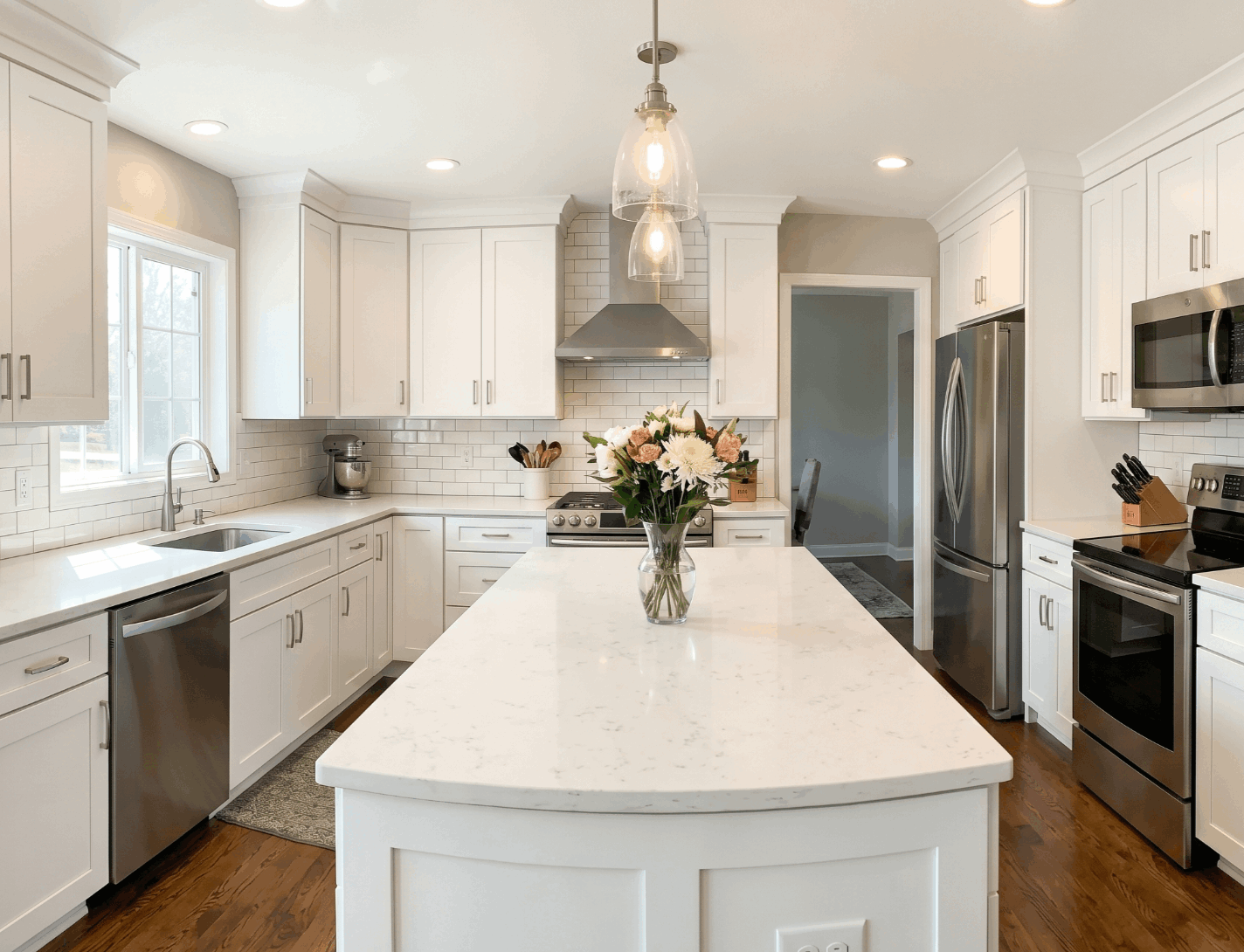
A complete kitchen remodel is one of the worst investments you can make before selling. The average major kitchen renovation returns somewhere around 50–60 cents on the dollar at resale — meaning you're spending $50,000 and getting maybe $25,000–$30,000 back. Buyers will also often redo kitchens to their own taste anyway. Cosmetic updates — hardware, a fresh coat of paint on cabinets, updated fixtures — are a much smarter use of money.
Full Bathroom Renovations
Same logic applies. A bathroom gut-renovation before selling rarely makes financial sense. Clean grout, fresh caulk, updated hardware and light fixtures, and a re-glazed tub can make an older bathroom look genuinely fresh for a few hundred dollars. That's almost always a better investment than a $20,000 renovation.
Adding Square Footage
Building an addition or finishing a basement before selling is almost never worth it. Construction is expensive, time-consuming, permits complicate the listing process, and buyers will pay you for square footage but rarely at the cost of what you spent to create it. If you were planning to enjoy the space yourself for years, that's a different conversation — but doing it specifically to sell is generally a losing proposition.
Luxury Upgrades in a Non-Luxury Neighborhood
The market caps your home's value at the level of comparable sales in your neighborhood. If every other home on your street sells in the $700s, a $50,000 kitchen renovation is not going to push your home to $900,000. You'll put money in and buyers will pay you what the neighborhood supports — no more. This is called "overimproving," and it's one of the most common ways sellers leave money on the table.
 Personalized Design Choices
The bold wallpaper you love, the bold paint colors throughout, the highly specific aesthetic you've cultivated over years — buyers want to imagine their own lives in a home. Anything that feels highly personalized tends to narrow your buyer pool rather than expand it. Neutral doesn't mean boring; it means broadly appealing.
The Decision Framework: Do This Before You Spend Anything
Before you invest in any pre-listing improvement, I'd encourage you to run it through this simple filter:
| Question to ask | If YES | If NO |
|---|---|---|
| Will buyers notice this on a showing or in photos? | Worth considering | Skip it |
| Will it come up in the home inspection? | Fix it — inspections can kill deals | Lower priority |
| Is it something buyers typically customize themselves? | Skip it — let them choose | More likely worth addressing |
| Can you recover most of the cost based on comparable sales? | Stronger case to proceed | Reconsider |
| Does it address a deferred maintenance issue? | Almost always worth fixing | Evaluate case by case |
A Note Specific to North Shore Sellers
Our market has some characteristics that affect this conversation directly. Historic homes — particularly in Salem, Beverly, and Danvers — are often bought for their original details. If you have original hardwood floors, period moldings, original windows with historical character, or other features that speak to the age and provenance of the home, these are not things to modernize away. They're selling points. Buyers who want a colonial with original detail are not cross-shopping with buyers who want a turnkey contemporary — they're looking for something specific, and your job is to make sure those features are clean, documented, and visible.
Similarly, coastal properties carry particular buyer scrutiny around moisture, salt air damage, and deferred maintenance. Things like exterior wood condition, roof and gutter health, and basement moisture issues will come up in every inspection. Getting ahead of them — either by fixing them or being transparent about them — is almost always the smarter strategy.
The most common mistake I see sellers make isn't spending too little — it's spending the wrong money in the wrong places. A $500 cleaning and a $1,200 paint job will outperform a $15,000 bathroom renovation in terms of net return more often than you'd think.
The second most common mistake is making improvements without getting a professional opinion first. I do pre-listing walkthroughs for a reason — I can tell you in about 45 minutes what's worth doing and what's not. That conversation is free. The renovation you regret is not.
Quick-Reference Summary
| Improvement | Do It? | Notes |
|---|---|---|
| Fresh interior paint (neutral tones) | Yes | One of the best returns available |
| Exterior paint / trim touch-up | Yes | Critical on coastal homes |
| Deep cleaning + declutter | Yes | Non-negotiable — do this first |
| Hardwood floor refinishing | Usually yes | Especially if you have hardwood under carpet |
| Landscaping and curb appeal | Yes | High visibility, low cost |
| Garage door replacement | Often yes | One of the top ROI projects nationally |
| HVAC service + documentation | Yes | Removes a common inspection concern |
| Bathroom cosmetic updates | Selectively | Hardware, caulk, fixtures — yes. Full renovation — no. |
| Kitchen cosmetic updates | Selectively | New hardware and paint? Yes. New cabinets? Probably not. |
| Full kitchen remodel | No | ~50–60% ROI. Rarely makes sense before selling. |
| Full bathroom gut renovation | No | Buyers will redo it anyway. Cosmetic update instead. |
| Addition or new square footage | No | Too expensive, too slow, recovery is poor. |
| Luxury finishes in mid-tier home | No | The neighborhood caps your value, not your renovation. |
Frequently Asked Questions
More Resources for North Shore Sellers
If you're getting ready to sell on the North Shore, these pages may be helpful:
- Browse current North Shore listings — see what's on the market and how competing homes are positioned
- Buyer guides and seller resources — more articles covering the North Shore real estate market
- Request a free home valuation — understand what your home is worth before you decide what to invest in it
Not Sure What Your Home Needs Before You List?
I do pre-listing walkthroughs for sellers throughout Beverly, Salem, Danvers, and the surrounding North Shore communities. It's a straightforward conversation — no pressure, no obligation — about what's worth doing and what isn't.
Get Your Free Home ValuationArmstrong Field Group · Aluxety Real Estate · North Shore MA

Categories
- All Blogs (200)
- Beverly, MA (14)
- Buying a Home (96)
- Condos For Sale (7)
- Danvers, MA (2)
- Estates & Inherited Homes (3)
- Gloucester, MA (1)
- Home Ownership (49)
- Home Sellers Guide (20)
- Homes For Sale (10)
- Ipswich, MA (2)
- Jim Armstrong (1)
- Landlords (1)
- Living on the North SHore (31)
- Mortgages (16)
- Peabody, MA (1)
- Prospective Real Estate Agents (1)
- Real Estate Careers (7)
- Real Estate Market Conditions (44)
- Real Estate School (2)
- Renting (1)
- Salem, MA (15)
- Selling a home (104)
- Senior Living (2)
- Swampscott, MA (1)
Recent Posts