
How Much Is My Home Worth Right Now in Massachusetts?

Determining your home’s value in Massachusetts is less about finding a single static number and more about understanding a moving target. In 2026, the Commonwealth's market is characterized by a "recalibration"—moving away from the frenetic bidding wars of the early 2020s toward a more balanced, but still highly competitive, environment.
Here is a deep dive into the four critical drivers that dictate what your Massachusetts home is actually worth today.
1. The "Hyper-Local" Comp Strategy
In Massachusetts, "comparable sales" (comps) are the gold standard, but their relevance expires quickly.
-
The 90-Day Window: Because the market is currently in a transitional phase, a sale from six months ago might as well be from six years ago. Professionals focus on properties that went under contract in the last 30 to 90 days to capture current buyer sentiment.
-
The "Micro-Market" Effect: Massachusetts is a state of distinct pockets. A colonial in the Metrowest suburbs (like Natick or Framingham) is valued differently than a triple-decker in Dorchester or a coastal home on the North Shore. Value is driven by proximity to the MBTA Commuter Rail, school district rankings, and local inventory levels.
2. Supply vs. Competition: The 2026 "Inventory Thaw"
For years, Massachusetts faced a "lock-in" effect where homeowners wouldn't sell because they didn't want to trade a 3% mortgage for a 7% one.
-
Rising Options: In 2026, we are seeing an "inventory thaw." More homes are hitting the market as rates stabilize in the low-to-mid 6% range.
-
The "Absorption Rate": Your value is heavily influenced by how many other homes in your town are for sale. If your neighborhood has only two months of supply, you still have massive leverage. If new construction or a surge of listings creates six months of supply, buyers will be more selective, and your "worth" may flatten.
3. The "Move-In Ready" Premium
In the current economic climate, the gap between "fixer-uppers" and "turn-key" homes has widened significantly.
-
The Cost of Labor: With high renovation and labor costs in New England, today’s buyers are willing to pay a massive premium to avoid a renovation.
-
High-ROI Upgrades: In Massachusetts, value is currently found in:
-
Energy Efficiency: Solar panels, heat pumps, and updated insulation (often supported by Mass Save programs).
-
Functional Flex Space: Finished basements or attics that serve as home offices.
-
Curb Appeal: In a "recalibrating" market, the first impression determines if a buyer even walks through the front door.
-
4. Why Online Estimates Often Miss the Mark
While Zestimates or Redfin Estimates are convenient, they are essentially "blind" algorithms.
-
The "Condition Blind Spot": An algorithm doesn't know you just spent $50,000 on a chef’s kitchen or that your neighbor’s "comp" house had a failing roof.
-
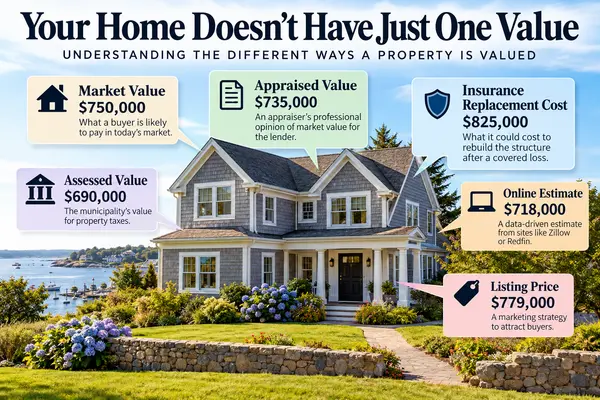
The "Unique Property" Tax: Massachusetts is famous for historic homes and unique layouts. Algorithms struggle with non-cookie-cutter properties, often resulting in an error margin of 3% to 7%—which, on a $700,000 home, is a $50,000 mistake.
Your home isn't just a collection of square footage; it's a participant in a complex, local ecosystem. To move from a "guess" to a "strategy," you need a valuation that accounts for the specific street you live on and the specific buyers looking right now.
👉 Get an instant valuation of your home at armstrongfield.com/evaluation
Frequently Asked Questions: Massachusetts Home Values
1. Does the "Mass Save" program affect my home value?
Absolutely. Buyers in 2026 are highly conscious of energy costs. Features like professional insulation, heat pumps, and high-efficiency windows—often upgraded through Mass Save—can significantly increase your home's appeal and market value compared to draftier "un-improved" neighbors.
2. How much does a "bad" school district impact my price?
In Massachusetts, school districts are a major driver of demand. However, homes in lower-rated districts often offer more square footage for the price, attracting remote workers and those without children. Your valuation must be compared to homes within the same district to be accurate.
3. Will my home's value drop in the winter months?
Listing inventory typically drops in the New England winter, meaning less competition for you. While there may be fewer buyers, those who are looking in January are usually highly motivated and ready to close. Your value stays stable, but your "days on market" might vary.
4. Why is my tax assessment different from my market value?
Tax assessments are for municipal revenue and are often based on older data. Market value is what a living, breathing buyer is willing to pay today. These numbers rarely match, and your assessment should not be used to set your listing price.
Ready to see the real numbers for your property?
Contact: Jim Armstrong
jarmstrong@armstrongfield.com
978-394-6736
Categories
- All Blogs (193)
- Beverly, MA (13)
- Buying a Home (92)
- Condos For Sale (6)
- Danvers, MA (2)
- Estates & Inherited Homes (3)
- Gloucester, MA (1)
- Home Ownership (49)
- Home Sellers Guide (18)
- Homes For Sale (10)
- Ipswich, MA (2)
- Jim Armstrong (1)
- Landlords (1)
- Living on the North SHore (30)
- Mortgages (15)
- Peabody, MA (1)
- Prospective Real Estate Agents (1)
- Real Estate Careers (7)
- Real Estate Market Conditions (43)
- Real Estate School (2)
- Renting (1)
- Salem, MA (14)
- Selling a home (100)
- Senior Living (2)
- Swampscott, MA (1)
Recent Posts