

Radon - The Invisible Threat Hiding in Your North Shore Home
The Invisible Threat
Hiding in Your Home
Radon gas is the second-leading cause of lung cancer in the United States — and North Shore homeowners face elevated risk thanks to the region's deep granite geology. Here's what you need to know.
You can't see it. You can't smell it. You can't taste it. But right now, radon gas may be seeping into your home through cracks in the foundation, gaps around pipes, or directly through the concrete slab — silently accumulating to levels that put you and your family at serious risk.
On Massachusetts' North Shore — from Salem to Beverly, from Danvers to Gloucester, from Marblehead to Rockport — the granite bedrock that makes our coastline so dramatically beautiful also makes our homes among the higher-risk in New England for elevated radon levels.
This guide will walk you through where radon comes from, why the North Shore's geology matters, how to test your home, and most importantly — what you can do about it.
The EPA estimates that about 21,000 Americans die from radon-related lung cancer every year — more than drunk driving. The EPA recommends mitigation when indoor radon levels reach 4 pCi/L (picocuries per liter) or above, and considers action at levels between 2–4 pCi/L. The average indoor level in the U.S. is about 1.3 pCi/L. Many untested North Shore homes exceed the action threshold.
Where Does Radon Come From?
Radon is a naturally occurring radioactive gas produced by the decay of uranium and thorium — elements found in varying concentrations in rocks and soil all over the world. It belongs to a decay chain that begins with uranium-238 and ends (eventually) at stable lead. Along the way, radium decays into radon-222, a gas that can migrate through soil and rock and into the air we breathe.
The North Shore Granite Connection
The North Shore of Massachusetts sits atop some of the oldest granite formations in New England — the same geological forces that carved out Rockport's granite quarries, shaped Gloucester's rocky coastline, and gave Salem's Pickering Wharf its rugged foundation.
Granite is naturally rich in uranium and thorium. As these elements decay over millennia, they produce radium — which produces radon. The gas travels along fractures in the bedrock, rises through the soil, and finds its way into your basement or crawl space through even the tiniest gaps.
Because radon is a gas, it follows pressure differentials — your home is typically at slightly lower pressure than the soil around it, especially in winter when homes are sealed tight and furnaces are running. This "stack effect" essentially turns your foundation into a radon vacuum. The gas enters and, with no ventilation to dilute it, concentrates to potentially dangerous levels.
"Radon is the largest environmental radiation health problem in the United States — affecting millions of homes, most of which have never been tested."
— U.S. Environmental Protection AgencyIn towns like Topsfield, Hamilton, Essex, Ipswich, and Wenham — where homes often sit closer to exposed ledge and thinner soil cover — the pathway from bedrock to basement can be especially short. But radon doesn't discriminate by zip code; newer homes in Peabody, Beverly, and Danvers can have just as much of a problem as a century-old colonial in Swampscott or Nahant. The source is below you, not inside the walls.
Understanding Radon Risk Levels
Radon is measured in picocuries per liter of air (pCi/L). Here's a quick reference for what the numbers mean:
| Level (pCi/L) | Risk Category | EPA Recommendation |
|---|---|---|
| Below 2.0 | Safe Zone | No action required; continue periodic testing |
| 2.0 – 3.9 | Consider Action | Mitigation is recommended; risk is real |
| 4.0 – 7.9 | Take Action | Fix your home; EPA action level threshold |
| 8.0 and above | Act Immediately | High risk; mitigate as soon as possible |
To put this in perspective: living in a home with 4 pCi/L of radon carries a lifetime lung cancer risk roughly equivalent to smoking half a pack of cigarettes per day. It's not a theoretical risk — it's a measurable, preventable one.
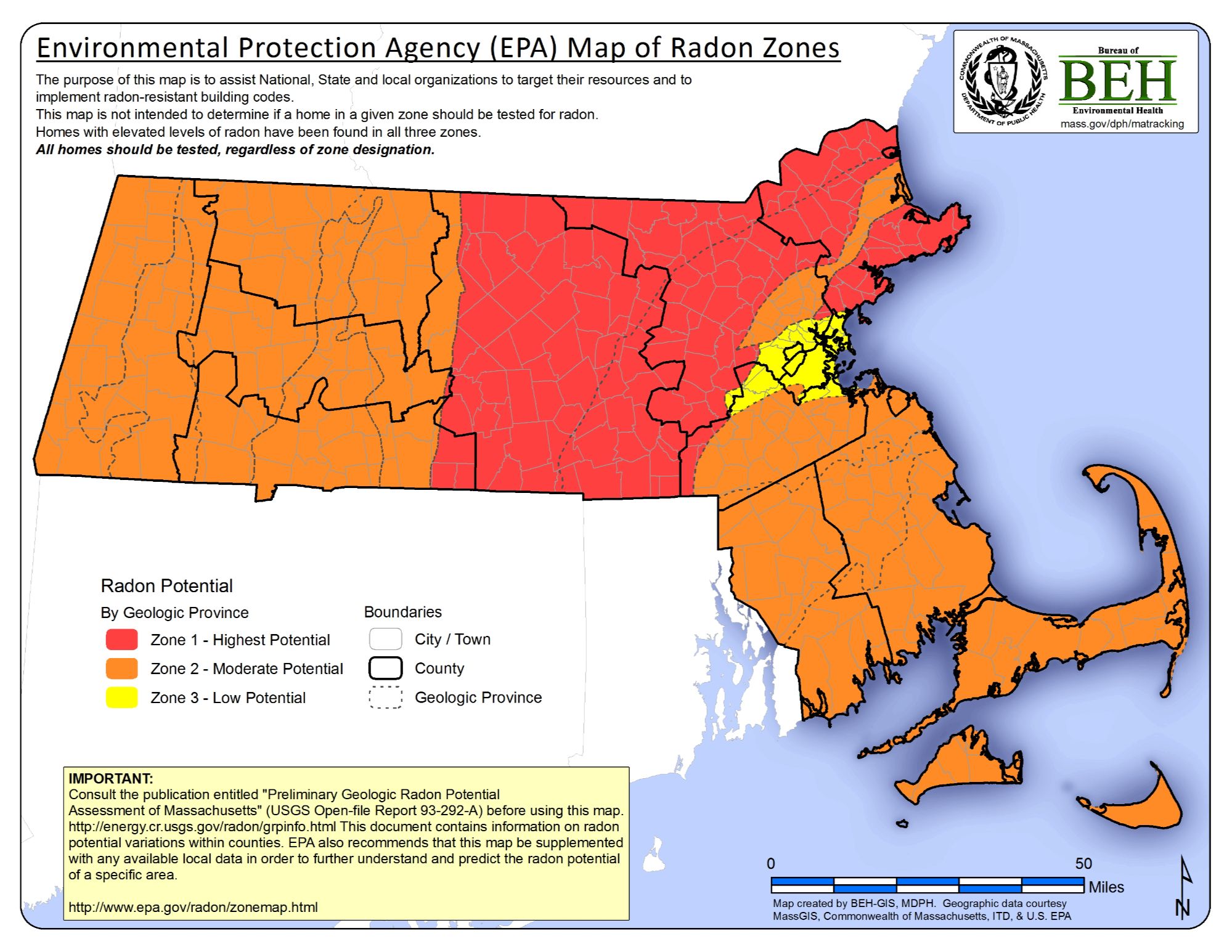
Radon Risk Map of Massachusetts
The EPA divides the country into three radon zones. Massachusetts is not uniformly risky — but the North Shore and areas underlain by granite and glacial till rank among the state's most elevated-risk regions.
Granite bedrock and glacial deposits contribute to consistently higher readings. Beverly, Salem, Danvers, Gloucester, Marblehead, Rockport, Ipswich, Hamilton, Topsfield, Wenham.
Interior Central MA has some of the state's highest documented radon averages, also driven by underlying granite and crystalline rock formations.
Variable geology means moderate average risk — but individual homes can still test well above the EPA action level depending on local conditions.
Sandy, glacial outwash soils allow radon to dissipate more easily. Still worth testing — "lower risk" doesn't mean zero risk.
Map is schematic and illustrative. Individual home test results can vary significantly within any zone. Always test your specific property.
How to Test Your Home for Radon
The good news: testing is simple, inexpensive, and the only reliable way to know your home's actual radon level. No geological map, no neighborhood average — only a real test in your actual living space will give you the number you need.
Choose a Test Method
There are two main options. Short-term tests (2–7 days) use passive charcoal canisters or electret ion chambers and give you a quick snapshot — good for real estate transactions or a first look. Long-term tests (90+ days) use alpha track detectors and give a more accurate picture of your year-round average exposure. For a definitive number, long-term is more reliable.
Place the Detector Correctly
Test in the lowest livable area of your home — a finished basement, first-floor bedroom, or any space you use regularly. Keep windows and doors closed as much as possible during the test (especially for short-term tests). Keep the detector away from exterior walls, drafts, and high-humidity areas.
Send It In or Read It
Passive kits get mailed to a certified lab; results come back in a week or two. Continuous electronic monitors (like the Airthings Wave or RadonEye) give real-time readings you can watch on your phone. Electronic monitors are ideal for ongoing peace of mind and are what we use in our loaner program.
Interpret Your Results
If your average is below 2 pCi/L, you're in good shape — test again every few years. Between 2 and 4, consider mitigation. At or above 4 pCi/L, the EPA recommends fixing your home. Above 8, treat it with urgency.
What to Do If Your Levels Are High
An elevated radon reading is not a crisis — it's actionable information. Radon mitigation is a well-established field and the solutions are reliable, effective, and far less expensive than most homeowners fear.
Mitigation Options
Sub-Slab Depressurization (ASD)
The gold standard. A certified contractor installs a pipe through the slab and a fan that draws radon from beneath the foundation and vents it safely outside above the roofline. Reduces levels by up to 99%. Typical cost: $800–$2,500.
Crawl Space Encapsulation
For homes with crawl spaces, sealing the space with a heavy-duty vapor barrier and installing a depressurization fan can dramatically reduce radon entry. Often paired with moisture control.
Improved Ventilation
Increasing natural or mechanical ventilation can dilute radon — but this approach is less reliable than ASD and can conflict with energy efficiency goals in cold North Shore winters.
Seal Entry Points
Caulking cracks in the foundation floor and walls, sealing around pipe penetrations, and closing openings in concrete block walls can reduce radon entry as a supplement — but rarely enough on its own.
Always hire a Massachusetts-licensed radon mitigation contractor. Look for NRPP (National Radon Proficiency Program) or NRSB certification. After any mitigation, a post-mitigation test is essential to confirm the system is working. Most well-installed ASD systems bring levels well below 2 pCi/L.
North Shore Homeowners: A Few Things to Know
Given our region's granite geology, a few local realities are worth keeping in mind. Homes in Rockport and Gloucester — literally built on exposed or near-surface ledge — may have less soil buffer between the bedrock source and the living space. Older homes in Salem and Beverly with rubble-stone foundations can have multiple radon entry points. Ranch-style homes in Danvers, Peabody, and Beverly with slab-on-grade construction can show elevated readings even without a basement. And brand-new construction in Hamilton, Wenham, and Topsfield is not immune — in fact, tight modern construction can trap radon more effectively than older, draftier homes.
The bottom line: if you live on the North Shore and have never tested, you don't know your number. And your number matters.
Borrow a Radon Detector — On Us
We're loaning our professional-grade radon monitor to homeowners on the North Shore — absolutely free. You'll get real readings from your actual living space within days, with no guesswork and no obligation.
Available to homeowners in Beverly, Salem, Danvers, Gloucester, Marblehead, Swampscott, Rockport, Ipswich, Hamilton, Wenham, Topsfield, Peabody, Nahant & surrounding communities. Reach out to schedule your loan.
Radon & Real Estate: What Buyers and Sellers Need to Know
If you're buying or selling a home on the North Shore, radon should be on your checklist. In Massachusetts, sellers are not legally required to disclose radon test results — but most buyers today are savvy enough to request a radon test as part of the inspection contingency, and most buyers' agents will recommend it.
A radon test result above 4 pCi/L doesn't need to kill a deal. Mitigation is routine, effective, and relatively inexpensive — and it's a selling point, not a defect, when it's already installed and functioning. Many sellers in Beverly, Marblehead, and Salem proactively mitigate before listing. It's worth the conversation.
The Short Version
Radon is a real, significant, preventable health risk — and North Shore homeowners are among the most exposed in Massachusetts, thanks to our region's granite bedrock. The testing is simple and cheap. The mitigation, when needed, is reliable and affordable. The only thing that's not easy is living with uncertainty when the answer is this close.
Test your home. Know your number. If it's high, fix it. It's that simple — and that important.
Questions about radon on the North Shore? Reach out — we're happy to talk through what testing makes sense for your home, connect you with a certified mitigation contractor, or set you up with our loaner detector program.
Categories
- All Blogs (193)
- Beverly, MA (13)
- Buying a Home (92)
- Condos For Sale (6)
- Danvers, MA (2)
- Estates & Inherited Homes (3)
- Gloucester, MA (1)
- Home Ownership (49)
- Home Sellers Guide (18)
- Homes For Sale (10)
- Ipswich, MA (2)
- Jim Armstrong (1)
- Landlords (1)
- Living on the North SHore (30)
- Mortgages (15)
- Peabody, MA (1)
- Prospective Real Estate Agents (1)
- Real Estate Careers (7)
- Real Estate Market Conditions (43)
- Real Estate School (2)
- Renting (1)
- Salem, MA (14)
- Selling a home (100)
- Senior Living (2)
- Swampscott, MA (1)
Recent Posts