

When to Lower Your Asking Price — And How to Avoid Needing To
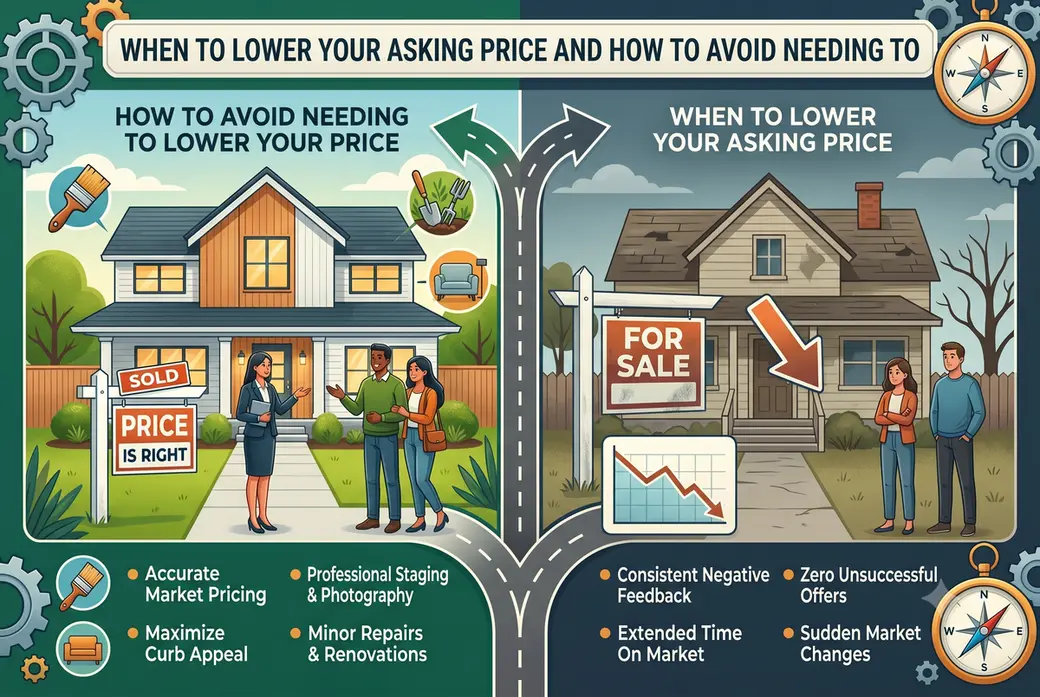
Seller Advice · North Shore Massachusetts
When to Lower Your Asking Price — And How to Avoid Needing To
The price you set on day one has more influence on your outcome than almost any other decision you'll make as a seller. Here's what happens when you get it wrong, and what to do about it.
Every seller on the North Shore wants to get as much as possible for their home. That's completely reasonable — selling a home is a major financial event, and you've likely put years of care and investment into the property. But wanting top dollar and pricing for top dollar are two different things, and the gap between them is where a lot of sales go sideways.
In my 25 years in real estate, overpricing is the single most common mistake I see North Shore sellers make. And the hard part is that it rarely feels like a mistake at first. The number looks good on paper. Your neighbors agree. Your agent might even go along with it. Then the weeks start going by.
Why the First Few Weeks Are Everything
When your home hits the market, there is a pool of buyers who have been waiting — sometimes for months — for something like your property to become available. They have their financing ready. They know the market. They are paying close attention to new listings.
These are your best buyers, and you only get one shot at them. If your price is too high, they look at your listing, compare it to what else is out there, and move on. They don't make lowball offers as a negotiating tactic. They simply leave, and their attention shifts to the next thing that comes along.
Once the active buyer pool has passed on your home, you're left waiting for new buyers to enter the market — a much slower process. Meanwhile, your days-on-market number is climbing, and that number is visible to everyone.
What Overpricing Actually Costs You
The financial case against overpricing is straightforward, but sellers often underestimate just how compounding the damage can be.
You miss the most motivated buyers. The buyers who are ready to act in the first two to three weeks of a listing tend to be the most serious. They have been looking for a while, they know value when they see it, and they move quickly. Price them out and they're gone.
Your listing goes stale. Buyers and their agents notice how long a home has been on the market. After 30 days without a sale in a market like the North Shore — where well-priced homes routinely go under agreement in under three weeks — people start to wonder what's wrong. The assumption is rarely "the price is too high." It's more often "there must be something wrong with the house." That stigma is hard to shake even after a price reduction.
You carry the costs longer. Every additional month on the market means another mortgage payment, another heating bill, another round of maintenance. Those costs add up quickly and erode the net proceeds you were trying to protect.
You often end up lower than where you started. This is the counterintuitive part. Homes that go through one or more price reductions frequently close at prices below what they would have fetched with a sharp, confident list price from day one. The reductions signal uncertainty, which invites aggressive negotiation.
A Note on the "Price High and Negotiate" Strategy
Some sellers think pricing high gives them room to come down while still landing where they want. In a very hot seller's market with thin inventory, there are scenarios where this can work. In a more balanced market — or one that is softening — it almost always backfires. Most buyers today won't bother making an offer on a home they perceive as overpriced. They move on to a listing that feels fair and let yours sit.
How to Know Your Home is Overpriced
The market communicates very directly, if you know what to listen for. Here are the signals that your price needs attention:
- Very few showings in the first two weeks. If your listing has been active for 10 to 14 days and you've had minimal showing requests, that's not bad luck. That's the market telling you your price is out of range before buyers even walk in the door.
- Showings but no offers after three to four weeks. If people are coming through and not making offers, they're likely comparing your price to what they can get elsewhere — and yours isn't winning. Sometimes they'll tell your agent directly.
- Consistent feedback about price. Buyer's agents share feedback for a reason. If you're hearing the same thing from multiple sources, that's not a coincidence. One person's opinion is an outlier; five people's opinion is data.
- Comparable homes are selling for less than your asking price. If similar properties in your neighborhood or the surrounding area are going under agreement at prices below your list price, the market has told you where things stand.
- A low appraisal kills a deal. If you go under agreement and the appraisal comes in below your sales price, you've discovered the hard way what the home was actually worth. This is expensive in time, stress, and often money.
When to Make the Move
On the North Shore, where the active market moves faster than in many parts of the country, the feedback window is short. A home that is not generating meaningful interest within two to three weeks of listing needs a fresh look at the price.
The instinct is often to wait a little longer, or to make a small adjustment and see what happens. In my experience, neither approach serves sellers well. Waiting extends the stale-listing problem. Small reductions — dropping by 1% or 2% on a $900,000 home — often go unnoticed by buyers and accomplish very little except to extend the timeline further.
How Much Should You Cut?
The right reduction depends on how far off you were to begin with. A meaningful price change — one that re-engages the active buyer pool and generates new showings — typically needs to be in the range of 3% to 8%, depending on the price point and market conditions.
The goal is not to make the listing look cheaper. The goal is to get back in front of buyers who were already paying attention. A reduction that doesn't accomplish that is not a solution — it's just postponing the inevitable.
If you're going to reduce, do it decisively and do it once. Multiple small reductions over several months are one of the clearest signals that a seller is uncertain and reactive. Buyers notice. It invites low offers and drawn-out negotiations.
The Better Strategy: Get the Price Right From the Start
Everything I've described above is avoidable. The most effective pricing strategy is also the simplest: price your home accurately based on what the market is actually doing, not what you hope it will do.
That starts with an honest, data-driven conversation with your agent before you list. A good comparative market analysis looks at recent sales of genuinely comparable properties — similar size, condition, location, and features — and uses that data to establish a realistic price range. Not a ceiling you're trying to reach through wishful thinking, but a range that reflects where buyers are actually transacting.
On the North Shore, there are real factors that influence value in ways that don't show up cleanly in national data. Proximity to the water, whether a historic property's details have been maintained or covered up, commuter rail access, lot size in walkable downtown areas — these things matter and they vary significantly from street to street in towns like Salem, Beverly, Manchester, and Gloucester. Your agent should understand those nuances and price accordingly.
A Note on the North Shore Market
Inventory on the North Shore is still relatively tight (as of mid 2026), which has given sellers meaningful leverage on well-priced homes. But that leverage only works if the price is grounded in what comparable homes are actually selling for. Overpricing in a seller's market doesn't extend your advantage — it throws it away. Buyers here are sophisticated and have access to the same data your agent does.
Verify current market conditions with your agent before listing. Conditions change, and local data is always more reliable than national headlines.
If you price it right from day one, you don't have to manage stale listings, second-guess your strategy, or negotiate from a weakened position. You generate real interest early, you create competition among buyers, and you close at a number that reflects the genuine market value of your home — which, on the North Shore, is often a strong number.
Frequently Asked Questions
How long should I wait before lowering my asking price?
On the North Shore, where well-priced homes often move within two to three weeks, the feedback window is shorter than in slower markets. If you've had very few showings in the first two weeks — or showings but no offers after three to four weeks — it's time to have a frank conversation with your agent. Waiting longer rarely helps and usually hurts.
How much should I lower my price?
Small, incremental reductions rarely work. A cut of 1% to 2% on a $900,000 home is noise — buyers barely notice. A meaningful reduction moves buyers from awareness to action. Depending on how overpriced the home was, that often means a 3% to 8% adjustment. Your agent should help you land in a range that re-engages the active buyer pool, not just looks better on paper.
Will a price reduction make my home look like something is wrong with it?
It can — but the alternative is usually worse. A swift, confident reduction looks like a seller who is paying attention. A home that sits for 60 or 90 days and then drops raises far more questions. If you price it right from day one, you never have to worry about it.
What is the real cost of overpricing my home?
The costs are real and compounding: you miss the most motivated buyers who come through in the first few weeks, your listing develops a "stale" stigma, your carrying costs continue to accumulate, and you often end up selling for less than if you had priced it correctly from the start. Overpricing is not a negotiating strategy — it's a liability.
What are the signs that my North Shore home is overpriced?
Few or no showings in the first two weeks. Showings but no offers after three to four weeks. Consistent feedback from buyers or their agents that the price is too high. Comparable homes nearby selling for less than your asking price. A low appraisal that stops a deal in its tracks.
Does pricing a home high and negotiating down ever work?
Occasionally, in a very hot seller's market with very limited competition, pricing slightly above comparable sales can work because buyer demand pushes values up. But "price high and negotiate down" as a standard strategy in a normal or softening market consistently backfires. Most buyers today won't bother making an offer on a home they perceive as overpriced — they simply move on.
Thinking about listing your home?
Before you set a price, let's look at what the market is actually doing. A pre-listing walkthrough and honest CMA costs you nothing and can make a significant difference in your outcome.
Read more about Selling and/or Schedule a Consultation
Categories
- All Blogs (198)
- Beverly, MA (13)
- Buying a Home (95)
- Condos For Sale (6)
- Danvers, MA (2)
- Estates & Inherited Homes (3)
- Gloucester, MA (1)
- Home Ownership (49)
- Home Sellers Guide (19)
- Homes For Sale (10)
- Ipswich, MA (2)
- Jim Armstrong (1)
- Landlords (1)
- Living on the North SHore (31)
- Mortgages (15)
- Peabody, MA (1)
- Prospective Real Estate Agents (1)
- Real Estate Careers (7)
- Real Estate Market Conditions (44)
- Real Estate School (2)
- Renting (1)
- Salem, MA (15)
- Selling a home (102)
- Senior Living (2)
- Swampscott, MA (1)
Recent Posts