
What Are ADUs & Why They Matter in Massachusetts | 2025/2026 Update
Accessory Dwelling Units (ADUs) are small residential living spaces located on the same lot as a principal home — like a finished basement apartment, an attached addition, or a detached backyard cottage. They’re also commonly called granny flats, in-law apartments, or secondary suites.
A New Era for ADUs in Massachusetts
Thanks to major housing legislation signed in August 2024, ADUs are now allowed by-right in single-family zoning districts across the Commonwealth. This means that, starting February 2, 2025, homeowners no longer need a special permit, variance, or discretionary zoning approval at the local level to build one ADU on their property.
The law is part of the Affordable Homes Act (Chapter 150 of the Acts of 2024), designed to address the state’s housing shortage by increasing the supply of smaller, flexible housing units statewide.
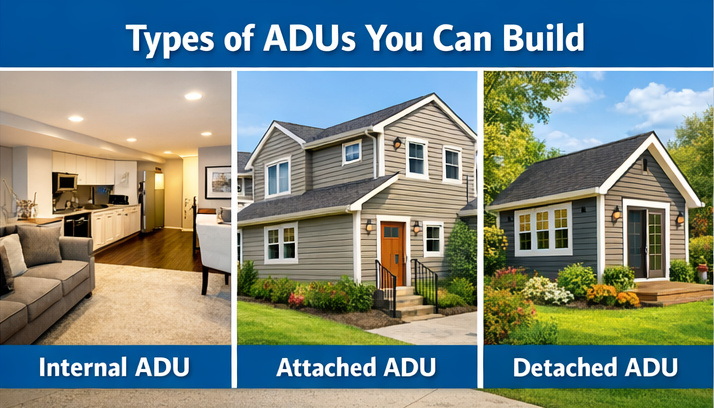 Types of ADUs You Can Build
ADUs in Massachusetts can take several forms, depending on your property and needs:
✅ Internal ADU – A unit created within the existing home (e.g., basement, attic, or a converted section).
✅ Attached ADU – An addition built onto the existing home with a separate entrance.
✅ Detached ADU – A standalone structure such as a backyard cottage or converted garage.
Each unit must have a separate entrance and meet basic building code requirements for safety.
Key Rules & Requirements
Here’s what homeowners need to know under the new statewide ADU law:
🔹 Size Limit:
An ADU must be no larger than 900 square feet or half the gross floor area of the main home — whichever is smaller.
🔹 Zoning By-Right:
Cities and towns must allow one ADU by-right in all single-family residential zoning districts. Municipalities may still apply reasonable local regulations (like setback or design standards), but they cannot ban ADUs outright or require special permits.
🔹 Owner-Occupancy:
Unlike many local bylaws of the past, the state ADU law does not require the homeowner to live on the property or in the ADU.
🔹 Parking:
Town zoning may include reasonable parking requirements, but the statewide law limits excessive additional parking mandates.
🔹 Short-Term Rentals:
Municipalities can restrict or prohibit ADUs from being used as short-term rentals (e.g., Airbnb) under certain conditions.
Note: Building and safety codes (like Title 5 septic requirements and state building code) still apply and may influence feasibility and cost.
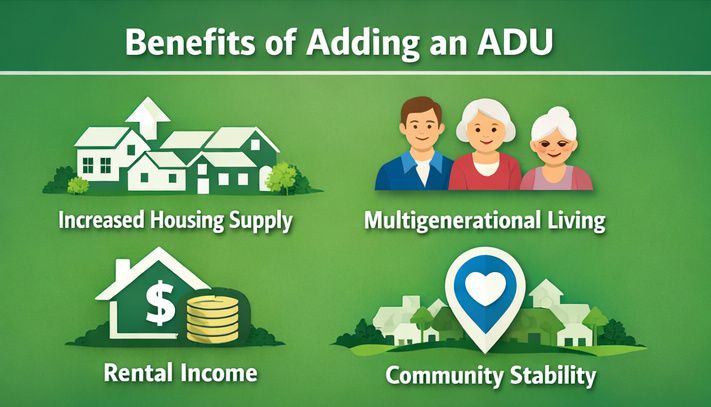 Benefits of Adding an ADU
Massachusetts sees ADUs as a practical tool to expand housing options without drastically altering neighborhood character. Here’s why they’re gaining attention:
🏡 Increased Housing Supply: ADUs help create new homes and alleviate local housing shortages. (Mass Healthy Aging Collaborative)
👵 Multigenerational Living: Great for aging families who want to stay close but maintain independence. (Mass Healthy Aging Collaborative)
💰 Rental Income: An ADU can provide steady rental income for homeowners. (Wikipedia)
📍 Community Stability: Helps young adults and others stay in the community longer. (Mass Healthy Aging Collaborative)
Challenges & Considerations
Despite streamlined permitting, some challenges remain:
🔸 Construction Costs: Labor, materials, and compliance (e.g., fire safety upgrades or septic improvements) can be expensive — sometimes $200,000–$500,000+ depending on the scope.
🔸 Local Regulations: Some municipalities may still have unique bylaws that add steps or requirements (within what state law allows).
🔸 Insurance & Code Compliance: Adding an ADU can affect homeowner insurance, zoning, and building inspections — it’s important to consult professionals early.
Final Thoughts
The Massachusetts ADU law marks a big shift in housing policy. By making ADUs easier to build statewide, homeowners now have a powerful tool to add housing supply, create rental income, or accommodate family members — all while contributing to more diverse and flexible housing options across communities. For more reading on ADUs, go to Massachusetts Government
If you’re considering an ADU, check with your local building and planning departments early, because every property and town has its own nuances within the state framework.
Got questions?
Jim Armstrong
Armstrong Field Group
Aluxety Real Estate
978-394-6736
Jarmstrong@armstrongfield.com
Categories
- All Blogs (193)
- Beverly, MA (13)
- Buying a Home (92)
- Condos For Sale (6)
- Danvers, MA (2)
- Estates & Inherited Homes (3)
- Gloucester, MA (1)
- Home Ownership (49)
- Home Sellers Guide (18)
- Homes For Sale (10)
- Ipswich, MA (2)
- Jim Armstrong (1)
- Landlords (1)
- Living on the North SHore (30)
- Mortgages (15)
- Peabody, MA (1)
- Prospective Real Estate Agents (1)
- Real Estate Careers (7)
- Real Estate Market Conditions (43)
- Real Estate School (2)
- Renting (1)
- Salem, MA (14)
- Selling a home (100)
- Senior Living (2)
- Swampscott, MA (1)
Recent Posts